2010-08-31
Explanation
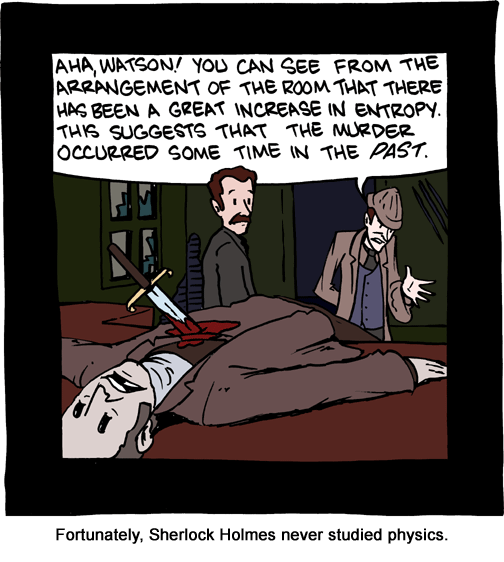
This comic imagines what would happen if Sherlock Holmes tried to apply physics instead of detective work to solve a crime. Holmes stands over a dead body with a knife in it and announces to Watson: "Aha, Watson! You can see from the arrangement of the room that there has been a great increase in entropy. This suggests that the murder occurred some time in the past." The caption reads: "Fortunately, Sherlock Holmes never studied physics."
The joke is that Holmes is using the second law of thermodynamics -- which states that entropy (disorder) in a closed system always increases over time -- to make a deduction that is technically correct but utterly useless. Yes, increased entropy does indicate that time has passed, and therefore the murder happened in the past. But that is true of literally everything that has ever happened. A real detective would use specific physical evidence to determine who committed the murder and when, but physics-Holmes can only tell you the blindingly obvious fact that the crime did not occur in the future. The comic plays on the idea that physics, while powerful for understanding the universe, is hilariously unhelpful for practical detective work.
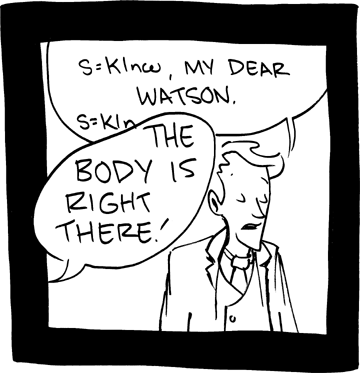
The votey panel continues the gag. Holmes smugly recites "S=klnW, my dear Watson" -- the Boltzmann entropy formula, where S is entropy, k is Boltzmann's constant, and W (or omega) is the number of microstates. Watson, exasperated, shouts "THE BODY IS RIGHT THERE!" -- pleading with Holmes to focus on the actual murder rather than reciting thermodynamics equations. The phrase "S=klnW, my dear Watson" is also a play on the famous (misattributed) Sherlock Holmes quote "Elementary, my dear Watson."