2011-02-02
Explanation
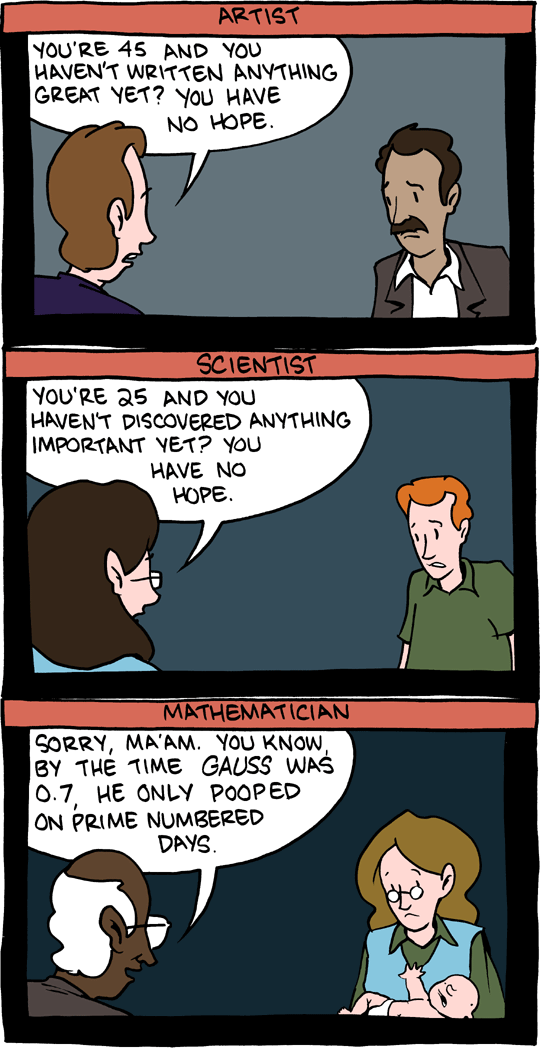
This comic compares how different fields make people feel inadequate about their accomplishments, with the pressure increasing as the field becomes more abstract. The first panel, labeled "Artist," shows someone telling a man, "You'''re 45 and you haven'''t written anything great yet? You have no hope." The second panel, labeled "Scientist," ratchets up the pressure: "You'''re 25 and you haven'''t discovered anything important yet? You have no hope." The third and final panel, labeled "Mathematician," goes to an absurd extreme: a woman with glasses tells a mother holding a baby, "Sorry, ma'''am. You know by the time Gauss was 0.7, he only pooped on prime numbered days."
The joke escalates the "prodigy anxiety" that exists in intellectual fields. In the arts, you might feel like a failure at 45. In science, the pressure starts at 25 (many great physicists and mathematicians did their best work young). But in mathematics, the comic suggests, the bar is set so impossibly high that even infants are judged against legends like Carl Friedrich Gauss -- one of the greatest mathematicians in history, who was famously a child prodigy. The claim that baby Gauss selectively pooped only on prime-numbered days is obviously absurd, but it perfectly captures the culture of intimidation around mathematical genius, where people routinely invoke the early achievements of historical prodigies to make everyone else feel inferior.
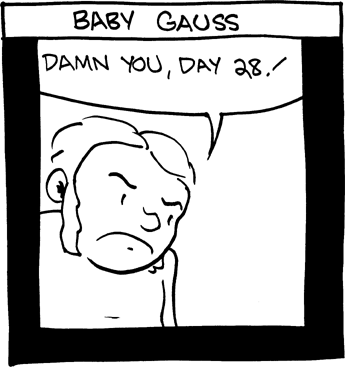
The votey panel shows "Baby Gauss" angrily saying, "Damn you, day 28!" -- because 28 is not a prime number (it is divisible by 2, 4, 7, and 14), so the legendary baby is furious at having to poop on a non-prime day, having failed to live up to his own impossible standard. This is also a subtle math joke: 28 is a perfect number (the sum of its proper divisors 1+2+4+7+14 = 28), so even Gauss'''s "failure" days are mathematically notable.