2011-12-08
Explanation
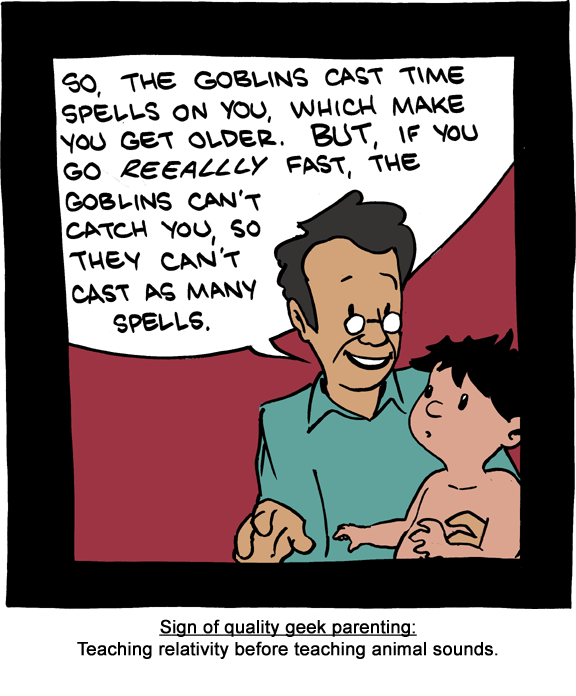
This comic shows a father holding a young child and explaining the concept of time dilation using a fantasy metaphor. He says: "So, the goblins cast time spells on you, which make you get older. But, if you go reeallly fast, the goblins can't catch you, so they can't cast as many spells." The caption below reads: "Sign of quality geek parenting: Teaching relativity before teaching animal sounds."
The father is explaining Einstein's theory of special relativity -- specifically time dilation -- to a toddler using terms the child might understand. In special relativity, as an object approaches the speed of light, time passes more slowly for that object relative to a stationary observer. The father has translated this into a fairy tale: "goblins" represent the passage of time, their "time spells" represent aging, and traveling very fast prevents the goblins from catching you, which maps onto how moving at high speeds causes time to slow down for the traveler.
The joke is about the priorities of "geek parents" who are so enthusiastic about science that they try to teach their babies about relativistic physics before even covering basic childhood fundamentals like what sound a cow makes. The caption frames this as a positive "sign of quality" parenting, playing into the geek culture pride of valuing scientific knowledge above all else.
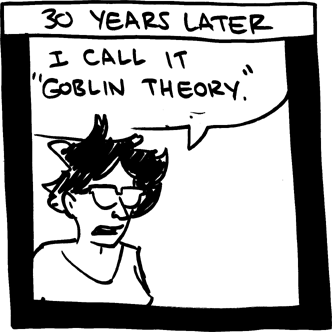
The votey shows the child grown up, 30 years later, saying: "I call it 'Goblin Theory.' " This suggests the child internalized the father's whimsical explanation so thoroughly that they grew up to be a physicist who still uses the goblin metaphor as their framework for understanding relativity, humorously implying that early childhood explanations can have lasting (and slightly embarrassing) effects on how we conceptualize ideas.