2012-07-14

Explanation
This multi-panel comic tells a sci-fi narrative about free will. It begins with the premise that humans did not have free will because they were "too macroscopic to access quantum randomness" and thus couldn't meet sufficient conditions for non-deterministic choices. A graph shows that as size increases, randomness decreases, with the human body falling on the low-randomness end. Scientists then build a "Quantum Access Chip" (Q.A.C.) that emits particles to scramble neuron activity, making choices "cease to be pre-determined." However, the users don't feel any different, and criminals start claiming they had "no choice" because they lacked a Q.A.C. chip. This leads to a political movement blaming only Q.A.C. users for bad outcomes (since they are the only ones with "free will"), culminating in a violent revolution against "free willers." The final panel shows that after killing all the quantum scientists, nobody has free will anymore -- and one character ominously asks, "Who's this 'we'?"
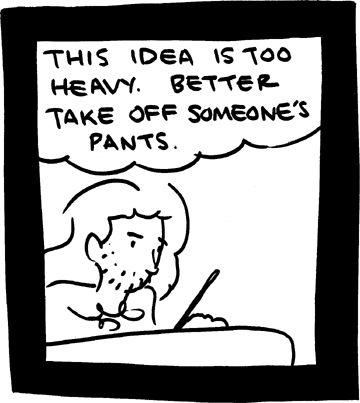
The comic is a satirical thought experiment about the philosophical debate over free will and determinism. It plays with the idea that quantum randomness might be the key ingredient for free will -- a real position held by some philosophers, though widely critiqued because randomness doesn't obviously give you "control" over your actions either. The humor escalates through the absurd social and political consequences: the philosophical distinction between "free" and "determined" agents becomes a political wedge issue, then a justification for revolution. The joke about the lack of pants being blamed on "the random motion of atoms in my body" highlights how introducing true randomness into decision-making doesn't produce anything that looks like meaningful choice. The final panel's dark twist -- "Who's this 'we'?" -- underscores that if nobody has free will, then even the revolutionary violence was predetermined, making the entire conflict tragically pointless.