2013-04-02
Explanation
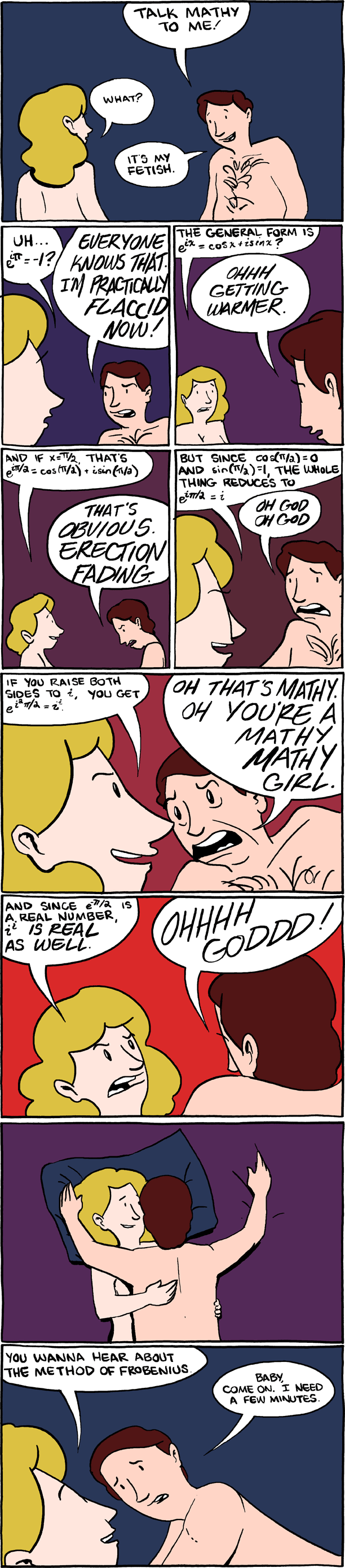
This comic depicts a couple in bed where the man asks the woman to "talk mathy to me," revealing it's his fetish. The woman starts with Euler's identity (e^(ipi) = -1), but the man dismisses it as too well-known: "Everyone knows that. I'm practically flaccid now." She escalates to the general form (e^(ix) = cos(x) + isin(x)), which he finds more exciting: "Ohhh, getting warmer."
She continues building the mathematical derivation step by step: substituting x = pi/2, showing that e^(ipi/2) = cos(pi/2) + isin(pi/2), noting that cos(pi/2) = 0 and sin(pi/2) = 1 so the expression reduces to e^(ipi/2) = i. She then raises both sides to the power of i, getting e^(i^2pi/2) = i^i. Since i^2 = -1, this becomes e^(-pi/2), and since e^(-pi/2) is a real number, i^i is real as well. This revelation -- that an imaginary number raised to an imaginary power yields a real number -- sends the man into ecstasy: "OHHHH GODDD!" He then asks, "You wanna hear about the method of Frobenius?" and she says she needs a few minutes to recover.
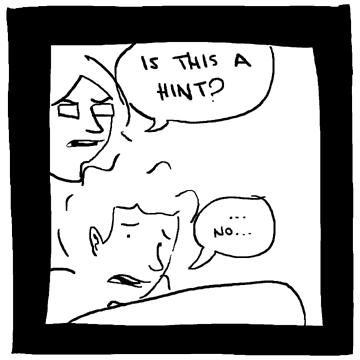
The comic is a love letter to mathematics disguised as a sex joke. The mathematical content is entirely accurate: i^i is indeed a real number (approximately 0.2079), and this is one of the most surprising and beautiful results in complex analysis. By framing it as erotic dialogue, Weinersmith humorously conveys the genuine excitement that math enthusiasts feel about elegant proofs. The votey shows the woman asking "Is this a hint?" with the man sheepishly replying "...No..." -- suggesting the comic itself might be the author's own thinly veiled math enthusiasm.