2013-05-19
Explanation
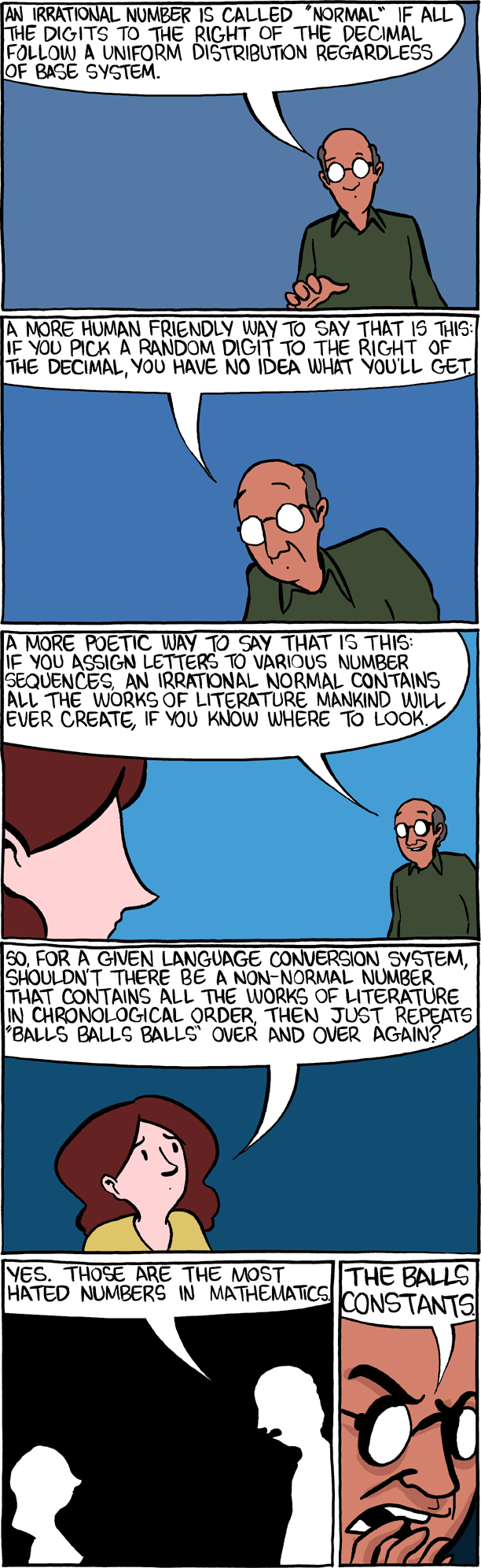
The comic features a professor explaining the mathematical concept of "normal" irrational numbers. He begins: "An irrational number is called 'normal' if all the digits to the right of the decimal follow a uniform distribution regardless of base system." He then offers a simpler explanation: "A more human friendly way to say that is this: if you pick a random digit to the right of the decimal, you have no idea what you'll get."
He provides a poetic interpretation: "A more poetic way to say that is this: if you assign letters to various number sequences, an irrational normal contains all the works of literature mankind will ever create, if you know where to look." This references the real mathematical property that a normal number's digit sequence contains every possible finite string of digits.
A woman then asks: "So, for a given language conversion system, shouldn't there be a non-normal number that contains all the works of literature in chronological order, then just repeats 'balls balls balls' over and over again?" The professor confirms: "Yes. Those are the most hated numbers in mathematics." He names them: "The Balls Constants."
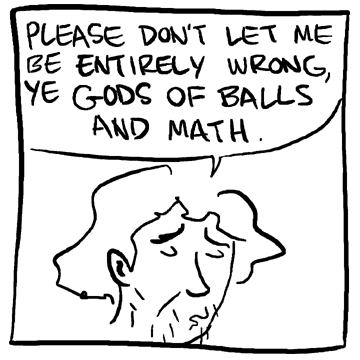
The humor comes from taking a genuinely fascinating mathematical concept and extending it to an absurd but technically plausible conclusion. You could indeed construct a real number whose decimal expansion encodes all human literature followed by infinite repetitions of "balls." The votey panel shows someone praying, "Please don't let me be entirely wrong, ye gods of balls and math," a self-deprecating acknowledgment by Weinersmith that he may have stretched the mathematics slightly for comedic purposes.