2013-06-08
Explanation
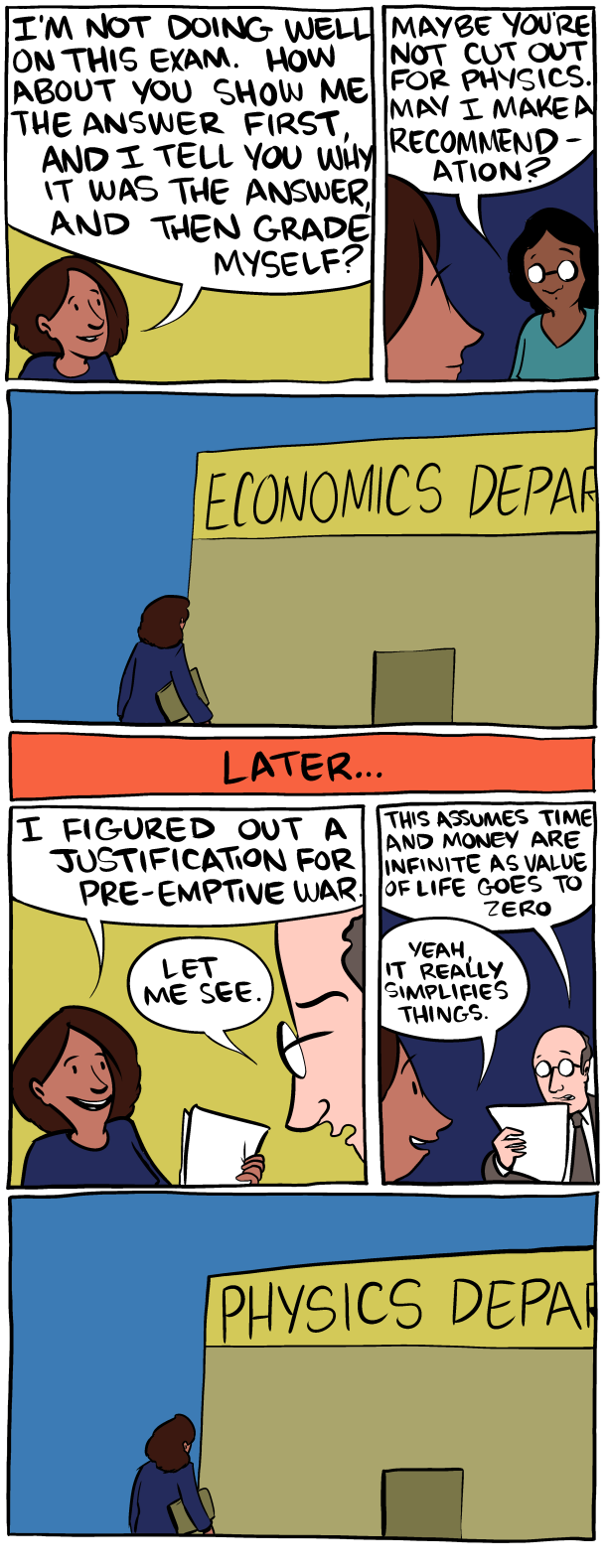
This comic draws a parallel between shady practices in two different academic departments. In the first panel, set in the Economics Department, a student who is not doing well on an exam asks the professor for an unusual arrangement: "How about you show me the answer first, and tell you it was the answer, and then grade myself?" The student is essentially asking for policy recommendations before analysis -- wanting to start with the conclusion and work backward. The professor seems to consider it, since the student asks "Maybe you'''re out for office? It has recommendations."
In the second panel, set in the Physics Department and labeled "LATER," a student has figured out "a justification for pre-emptive war." The physics work shown claims that something "approaches infinite value" and "it really changes things." The humor here is that a physics student has taken mathematical reasoning -- where values approach infinity or zero -- and repurposed it to justify something completely outside the domain of physics, namely pre-emptive war.
The comic satirizes how both economics and physics can be abused or misapplied to support predetermined conclusions. Economists are sometimes accused of working backward from political conclusions to find supporting models, while physicists and mathematicians can use the authority of precise-sounding calculations to lend false credibility to arguments in areas they know nothing about. Both departments are shown harboring people who twist their discipline'''s tools to serve agendas rather than truth.
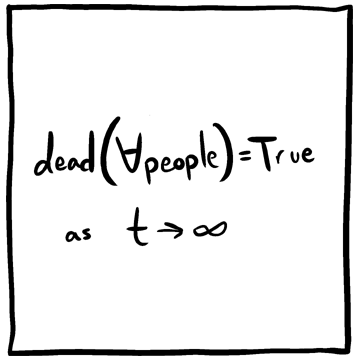
The votey panel shows a mathematical statement: "dead(for all people) = True as t approaches infinity" -- a darkly humorous formalization of the obvious fact that everyone dies eventually, written in the style of a mathematical proof. This connects to the comic'''s theme of using formal notation to state things that sound more profound than they are.