2013-06-29
Explanation
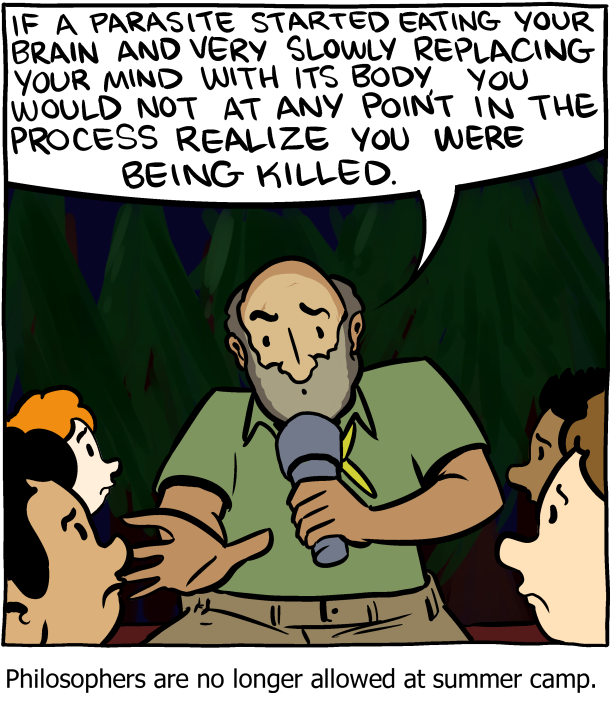
This comic shows an older man, apparently a philosopher, sitting around a campfire with children at what appears to be a summer camp. He tells them: "If a parasite started eating your brain and very slowly replacing your mind with its body, you would not at any point in the process realize you were being killed." The caption below reads: "Philosophers are no longer allowed at summer camp."
The philosopher'''s statement is a variation on classic thought experiments in philosophy of mind about personal identity and consciousness. It relates to the "Ship of Theseus" problem -- if you gradually replace every part of something, is it still the same thing? Applied to the brain, this becomes deeply unsettling: if a parasite slowly replaced your neurons one by one, there would presumably be no single moment where "you" stopped existing and the parasite began. Your subjective experience might continue seamlessly even as the physical substrate of your mind was completely replaced. This touches on questions about what consciousness actually is and whether identity can survive gradual physical transformation.
The humor comes from the absurd inappropriateness of sharing this terrifying philosophical insight with children at a campfire. Summer camp campfire stories are traditionally meant to be fun, mildly spooky ghost stories -- not genuine existential horror about the nature of consciousness and the fragility of personal identity. The caption delivers the punchline by confirming that this sort of behavior is exactly why philosophers get banned from normal social situations.
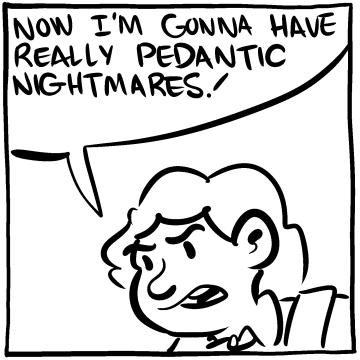
The votey panel shows a child saying "Now I'''m gonna have really pedantic nightmares!" which is a great additional joke -- the child will not just have regular nightmares, but philosophically precise ones, suggesting the philosopher'''s influence has already taken hold.