2013-07-28
Explanation
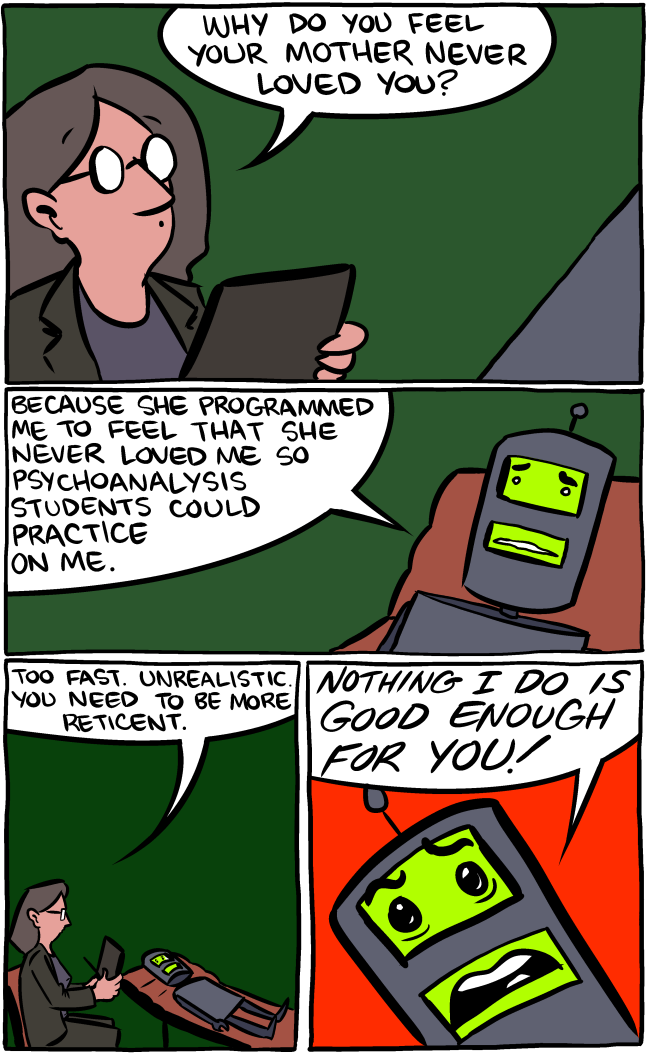
The comic imagines a future where artificial intelligence is advanced enough to require psychotherapy. A therapist asks a robot, "Why do you feel your mother never loved you?" The robot responds, "Because she programmed me to feel that she never loved me so psychoanalysis students could practice on me." In the final panel, the therapist says, "You need to be more realistic," and the robot retorts, "Nothing I do is good enough for you!"
The joke operates on several levels. First, it plays with the concept of AI consciousness and emotions. In psychotherapy, a patient's feeling that their mother never loved them is typically rooted in complex psychological dynamics. But for the robot, the explanation is purely literal and mechanical: the feeling was deliberately programmed in as a training exercise. This creates a funny tension between the psychoanalytic framework (which assumes deep, hidden emotional truths) and the robot's straightforward, engineering-based self-awareness.
The therapist's response -- telling the robot to be more realistic -- is ironic because the robot's explanation is actually perfectly realistic and literally true, while the therapist is trying to impose a human psychological framework that does not apply. The robot's frustrated reply, "Nothing I do is good enough for you!" is a classic therapy-patient outburst that paradoxically makes it seem more human and more in need of therapy, even though its original self-assessment was completely rational.
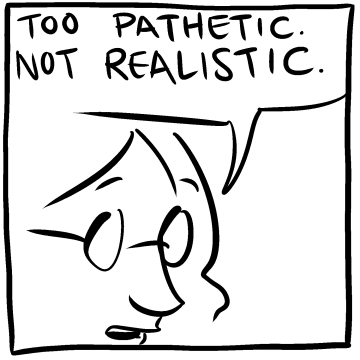
The votey shows someone saying, "Too pathetic. Not realistic," which may represent the programmer evaluating the robot's simulated emotional responses and finding them unconvincingly extreme -- adding yet another layer to the question of what constitutes "realistic" emotional behavior in an artificial being.