2013-09-26
Explanation
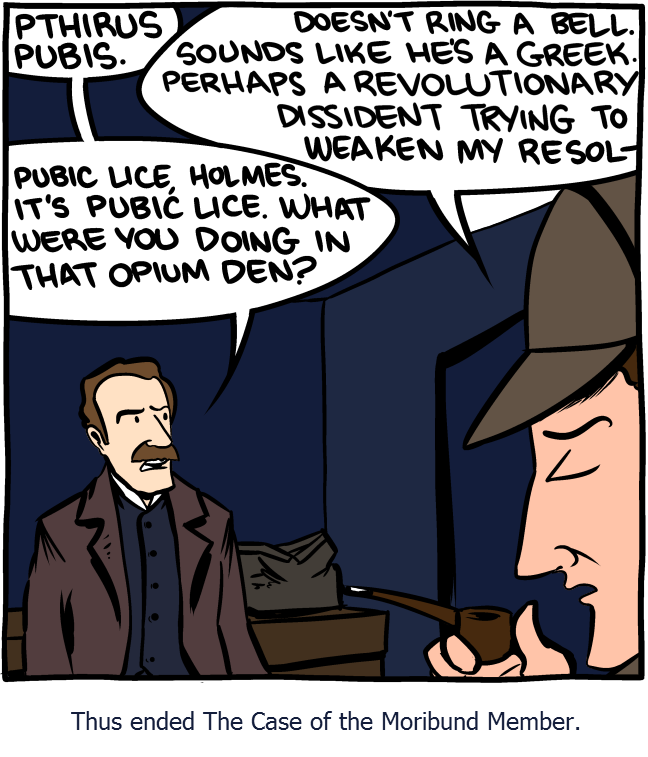
This comic depicts Sherlock Holmes and Dr. Watson in a scene styled after Arthur Conan Doyle'''s Victorian-era detective stories. Watson says "Pthirus pubis" and Holmes, not recognizing the term, muses that it "doesn'''t ring a bell" and speculates it sounds like a Greek name -- perhaps a revolutionary dissident trying to weaken his resolve. Watson then cuts in bluntly: "Pubic lice, Holmes. It'''s pubic lice. What were you doing in that opium den?" The caption at the bottom reads: "Thus ended The Case of the Moribund Member."
The humor works on several levels. First, there is the comedy of the world'''s greatest detective failing to recognize a common (if embarrassing) medical term. Pthirus pubis is indeed the scientific name for pubic lice (crab lice). Holmes'''s attempt to deduce the identity of "Pthirus Pubis" as a Greek revolutionary is hilariously wrong and reveals a blind spot in his supposedly encyclopedic knowledge. The reference to the opium den is a nod to the canonical Holmes stories, where Holmes'''s recreational drug use (including opium and cocaine) was a well-known character trait. Watson'''s question implies Holmes picked up the lice during one of his opium den visits. The case title, "The Case of the Moribund Member," is a double entendre -- "moribund" means near death, and "member" can refer both to a person and to a body part, making it a bawdy pun perfectly suited to the diagnosis.
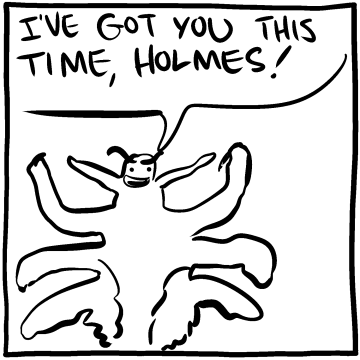
The votey panel shows a pubic louse (drawn as a cartoonish crab-like creature) declaring "I'''ve got you this time, Holmes!" -- casting the louse as Holmes'''s nemesis in the style of Professor Moriarty, his famous arch-enemy.