2013-10-09
Explanation
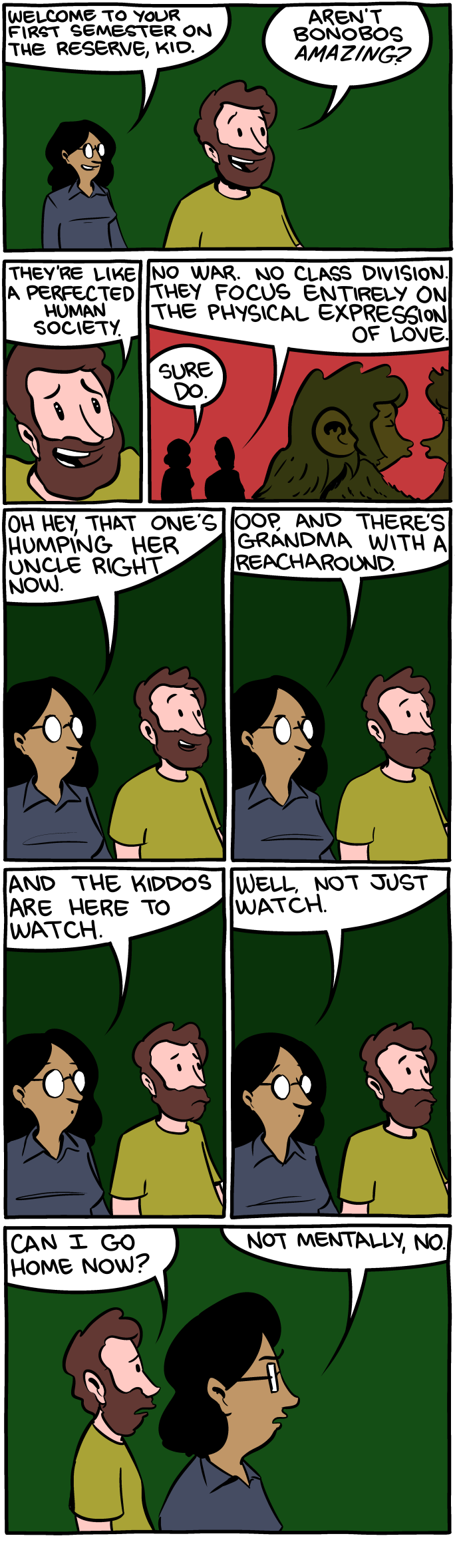
This comic depicts a scene at what appears to be a bonobo reserve, where an experienced guide is introducing a new visitor to the primates. The guide enthusiastically declares that bonobos are "amazing" and describes them as "a perfected human society" with "no war, no class division" that "focus entirely on the physical expression of love." This references the real-world reputation of bonobos, who are famous in primatology for resolving conflicts through sexual behavior rather than aggression, which has led some popular science writers to idealize them.
The joke unfolds as the visitor actually watches the bonobos and the guide starts narrating what is happening in graphic detail -- incestuous mating, elderly bonobos participating, and even juveniles being involved. The visitor, increasingly horrified, asks "Can I go home now?" to which the guide ominously replies "Not mentally, no" -- implying the visitor has been psychologically scarred by what they have witnessed.
The comic satirizes the tendency to romanticize bonobo society as a utopian alternative to human civilization. While it is true that bonobos are notably peaceful compared to chimpanzees and use sexual contact as a social bonding mechanism, the comic points out that applying human moral standards to their behavior reveals aspects that would be deeply disturbing by our norms. The humor comes from the collision between the idealized framing and the uncomfortable biological reality.
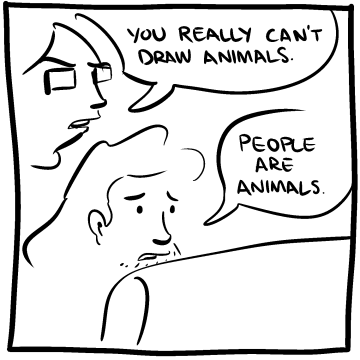
The votey panel features someone off-screen telling the artist "You really can''t draw animals," to which he responds "People are animals" -- a cheeky biological technicality that serves as both a self-deprecating joke about Zach Weinersmith''s art style and a thematic callback to the comic''s blurring of lines between human and animal behavior.