2013-10-29

Explanation
The Joke
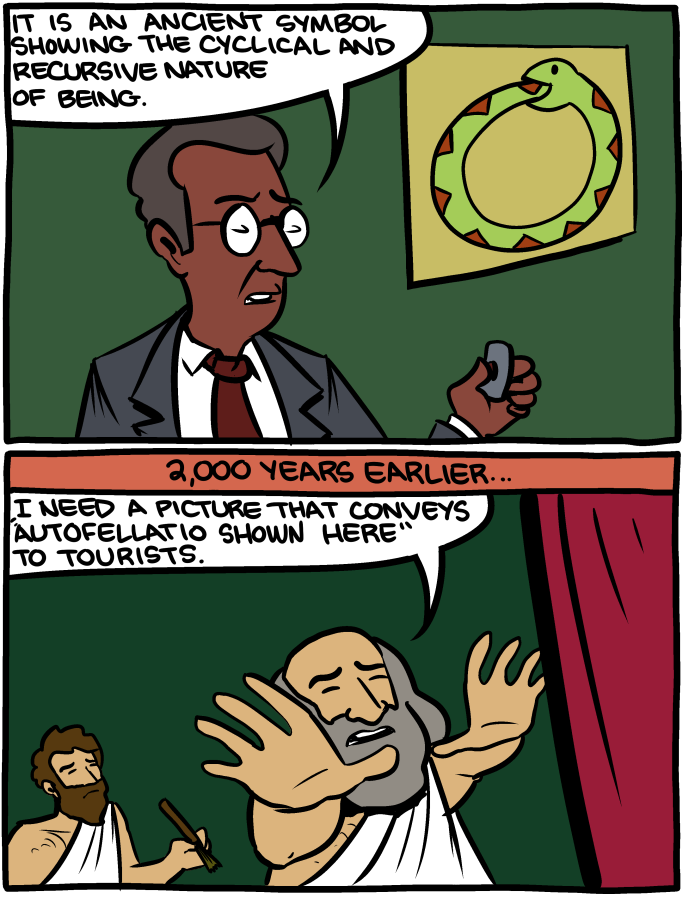
In the top panel, a modern-day professor or scholar presents an image of an ouroboros (a snake eating its own tail) to students, explaining it is "an ancient symbol representing the cyclical and recursive nature of being." In the bottom panel, labeled "2,000 years earlier," an ancient figure (resembling a Greek or Roman philosopher) stands before a curtain and says: "I need a logo that conveys autofellatio. Show me what you've got, fellas."
The Humor
The comic humorously deflates the lofty philosophical interpretation of the ouroboros by suggesting its true origin was far more crude and literal. Academics and mystics have long interpreted the ouroboros -- a serpent consuming its own tail in a circle -- as a profound symbol of eternal return, self-reflexivity, and the cyclical nature of existence. The punchline suggests that the original creator of the symbol had a much more vulgar and literal intention: the circular shape of a creature putting its own body part in its mouth is simply a crude visual joke. The humor lies in the contrast between the highbrow modern interpretation and the lowbrow supposed origin.
References
- Ouroboros: An ancient symbol depicting a serpent or dragon eating its own tail, found in Egyptian, Greek, and Norse mythology. It symbolizes cyclicality, eternal return, and self-reflexivity.
- Autofellatio: A crude act that the ouroboros shape visually resembles, forming the basis of the joke's reinterpretation.