2013-11-14
Explanation
The Joke
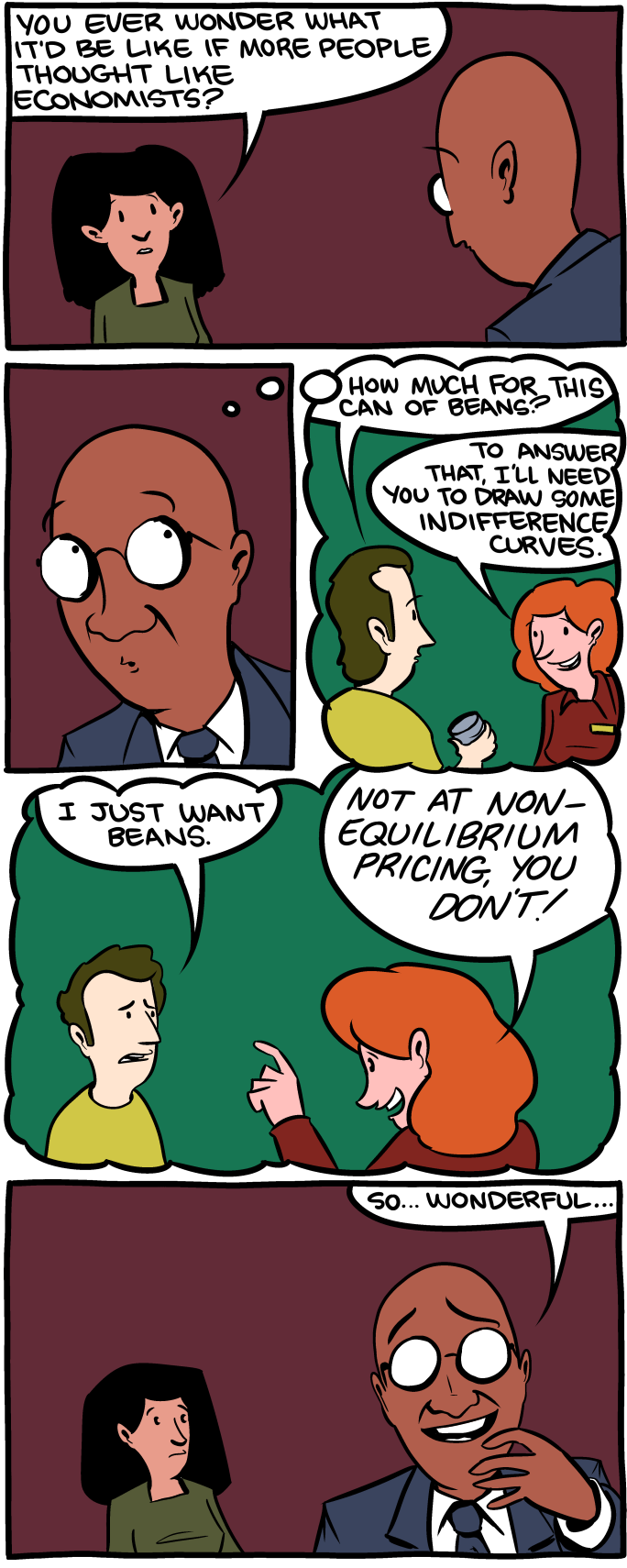
A man asks a woman, "You ever wonder what it'd be like if more people thought like economists?" The comic then shows a grocery store scenario: a customer asks "How much for this can of beans?" and the cashier responds, "To answer that, I'll need you to draw some indifference curves." When the frustrated customer says "I just want beans," the cashier snaps back: "Not at non-equilibrium pricing, you don't!" Back in the original scene, the man who posed the question says dreamily, "So... wonderful..."
The Humor
The joke satirizes how economists over-complicate simple transactions with academic jargon and theoretical frameworks. In real life, buying a can of beans involves looking at a price tag and paying. But an economist would insist on first establishing the buyer's indifference curves (graphs showing combinations of goods between which a consumer is indifferent) and would refuse to sell at "non-equilibrium pricing" (a price that doesn't reflect the theoretical market-clearing price). The punchline is that the man who asked the question finds this nightmarish scenario "wonderful" -- revealing that he is himself an economist who genuinely believes everyday commerce would be improved by injecting microeconomic theory into grocery shopping.
References
Indifference curves are a concept from microeconomics representing combinations of two goods that give a consumer equal satisfaction. Non-equilibrium pricing refers to prices that do not match the theoretical equilibrium where supply equals demand. Both are standard concepts taught in introductory economics courses.