2013-11-25

Explanation
The Joke
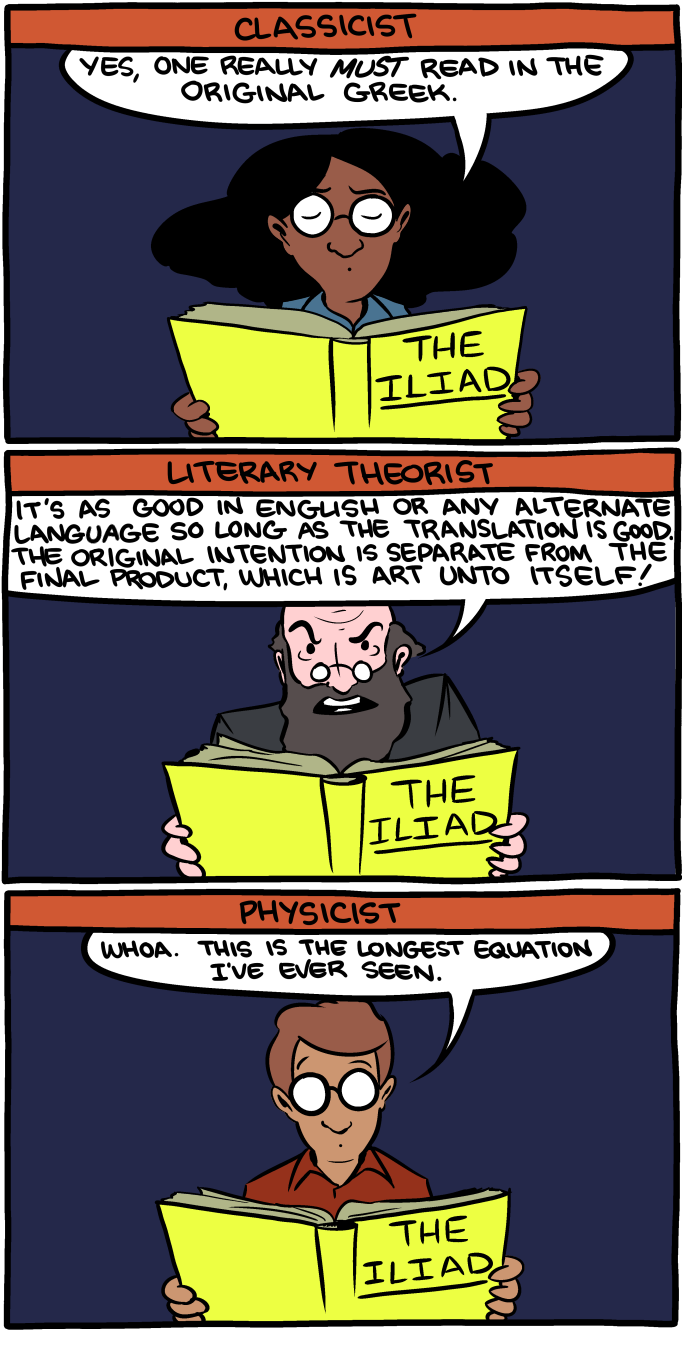
Three different academics are shown reading The Iliad, each responding according to their discipline. The Classicist says, "Yes, one really must read in the original Greek." The Literary Theorist says, "It's as good in translation or any alternate language so long as the translation is fair and one's attention is separated from the final product, which is art unto itself." The Physicist says, "Whoa. This is the longest equation I've ever seen."
The Humor
The joke contrasts three academic perspectives on the same text. The classicist takes the predictably snobby position that only the original Greek is adequate. The literary theorist offers an overly nuanced, jargon-laden counterpoint about the validity of translation -- a parody of how literary theory can make simple points in unnecessarily complex ways. The physicist, however, provides the real punchline: having no framework for understanding literature at all, the physicist can only interpret the text through the lens of their own discipline, seeing The Iliad as one very long equation. This plays on the stereotype that physicists and STEM-oriented people are so deeply specialized that they are unable to process anything outside their field. It also satirizes the idea that each academic discipline creates a lens so narrow that practitioners can only see the world through it.
References
The Iliad is an ancient Greek epic poem attributed to Homer, one of the foundational works of Western literature. It recounts events during the Trojan War. The comic plays on longstanding debates in classics and literary studies about whether translations can capture the essence of original texts.