2013-12-04

Explanation
The Joke
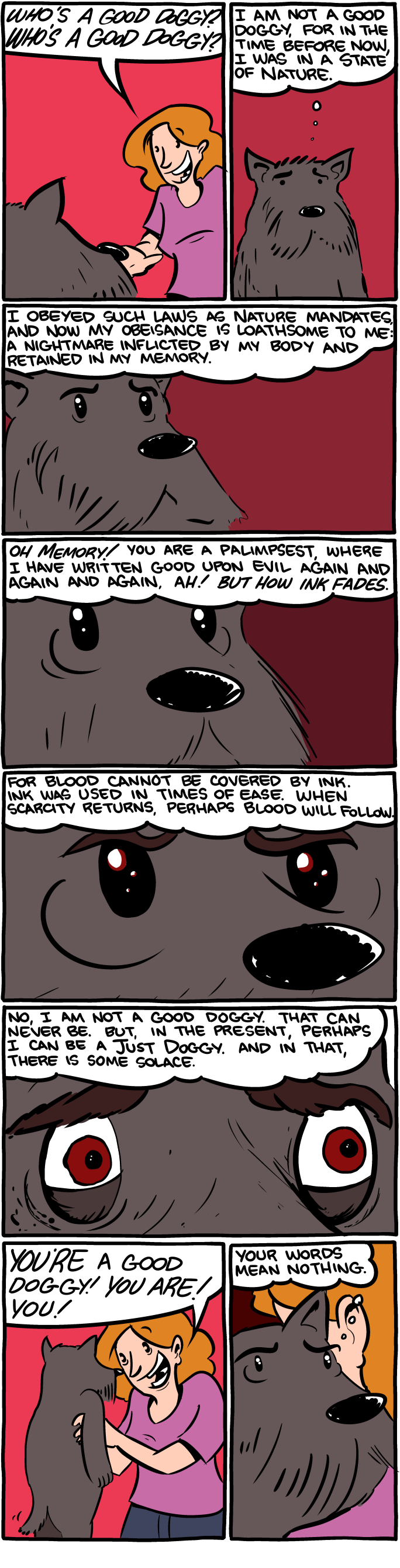
A woman cheerfully asks her dog, "Who's a good doggy? Who's a good doggy?" The dog responds with a deeply philosophical, dark interior monologue. It declares: "I am not a good doggy. For in the time before now, I was a storm of nature." The dog goes on to describe itself as having once been wild, driven by "nameless, mandretic instinct" and "violence," now reduced to "a nightmare inflicted by my body and sustained by my phantom." It describes its memory as a "palimpsest" overwritten with obedience, and warns that its "blood cannot be covered" and that when "scarcity returns, today's blood will fall." After this terrifying soliloquy, the dog concludes that no, it is not a good doggy -- it can only be "a just doggy." The woman, oblivious, continues: "You're a good doggy! You are!" The dog's final thought: "Your words mean nothing."
The Humor
The comedy comes from the extreme contrast between the woman's baby-talk and the dog's grim, Nietzschean inner monologue. While the owner sees an adorable pet, the dog sees itself as a barely domesticated predator with a violent ancestral heritage, philosophically rejecting the very concept of "good" in favor of "just." The language is deliberately overwrought and literary -- words like "palimpsest" and "mandretic" give the dog the voice of a brooding Gothic anti-hero. The final exchange is the punchline: the woman's oblivious cheerfulness versus the dog's nihilistic dismissal of her words. It plays on the common joke premise of "what if we could hear what dogs are really thinking?" but takes it to a darkly philosophical extreme.
References
The dog's monologue echoes themes from Friedrich Nietzsche's philosophy, particularly the idea of primal will suppressed by civilization. The word "palimpsest" refers to a manuscript that has been written over multiple times, used here as a metaphor for the dog's instincts being overwritten by domestication. The overall tone parodies dark literary monologues from Gothic and Romantic literature.