2014-01-06

Explanation
The Joke
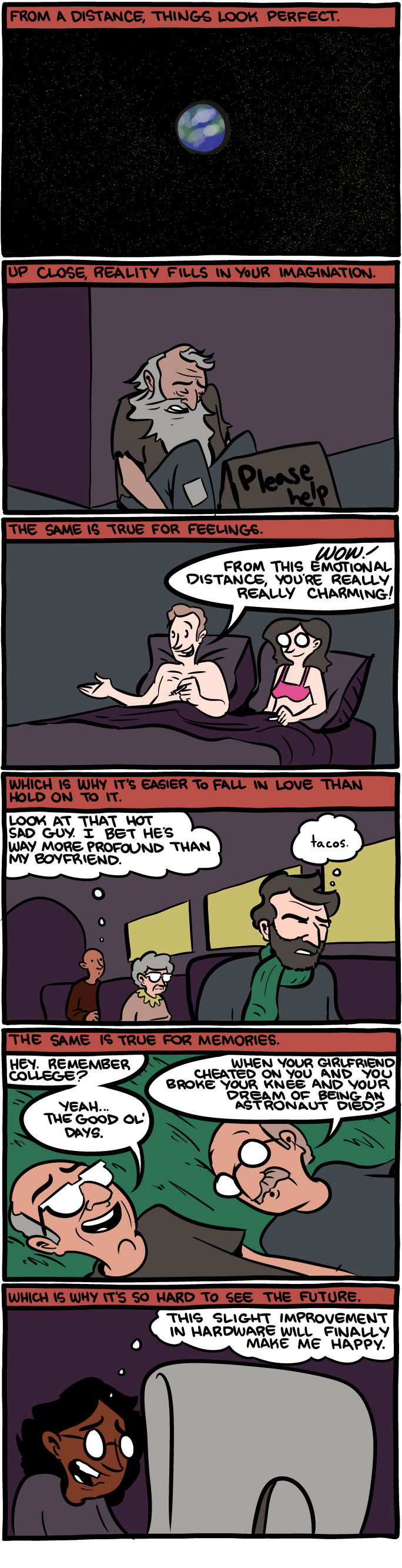
The comic explores the idea that "from a distance, things look perfect." It starts by noting that George Washington looks great from afar but up close reveals flaws ("Please help"). The same principle applies to friendships -- from emotional distance, your friends seem charming, which is why it is easier to fall in love than to hold onto it. The comic then applies this to computing: people look back fondly on "the good old days" of technology, but in reality, older computers were far worse. The final panel extends the observation to hardware improvements, with someone saying that "this slight improvement in hardware will finally make me happy" -- a sentiment that is always said from a distance (i.e., before you actually have it) and never actually delivers lasting satisfaction.
The Humor
The comic builds a philosophical argument through escalating examples, each applying the same principle -- that distance (physical, emotional, or temporal) creates an illusion of perfection. The humor comes from how universally applicable and deflating this observation is. Friendships, romantic relationships, nostalgia for old technology, and excitement about new technology all fall victim to the same cognitive bias. The joke about computing nostalgia is particularly pointed: people romanticize older, simpler computers while forgetting how terrible they actually were to use. The final panel delivers the ultimate punchline by showing that even the anticipation of future improvements is just another form of the same illusion -- we always believe the next upgrade will make us happy, but it never does. The comic is essentially a meditation on hedonic adaptation dressed up as a series of gags.
References
The opening reference to George Washington likely alludes to both Gilbert Stuart's famous idealized portraits and the broader tendency to mythologize historical figures. The computing nostalgia panels reference the common tendency to romanticize older technology, sometimes called "retrocomputing nostalgia."