2014-01-29

Explanation
The Joke
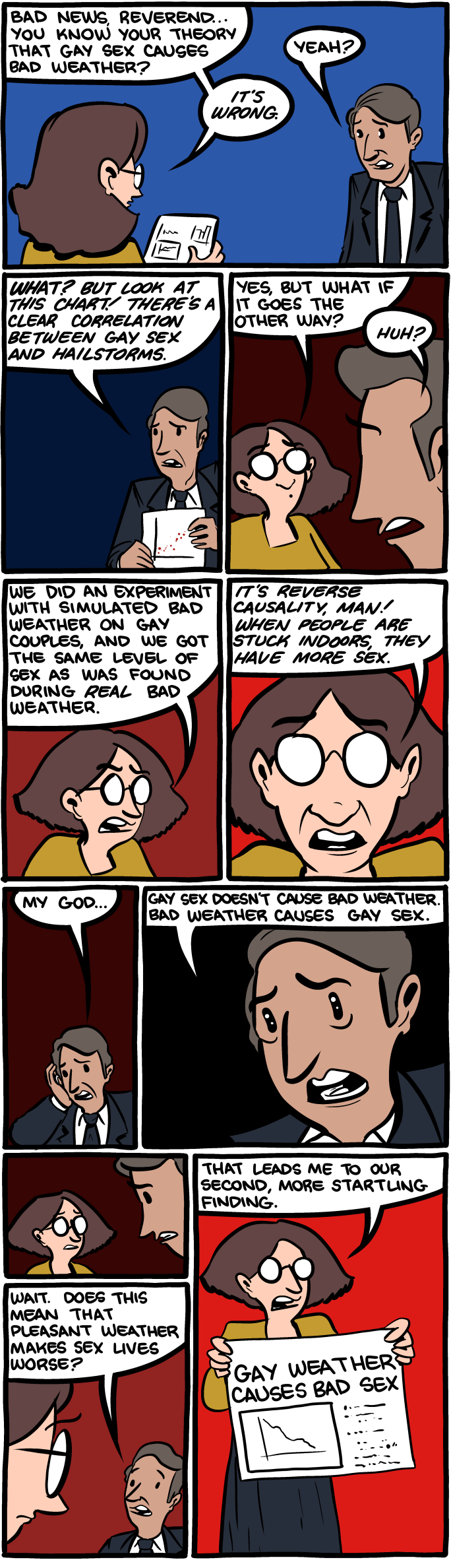
A reporter confronts a reverend about his theory that gay sex causes bad weather. The reverend confirms: "Yeah!" A scientist presents a chart showing a clear correlation between gay sex and bad weather, but asks what if the causation goes the other direction. They run an experiment with simulated bad weather (in a lab, of course) and find that subjects indeed had more gay sex during bad weather, suggesting it is reversed causality. The reverend is shocked: "My God... Gay sex doesn't cause bad weather. Bad weather causes gay sex." The scientist then says this leads to their "second, more startling finding," and the reverend asks what it means. The final panel reveals a poster that reads: "Gay weather causes bad sex."
The Humor
The comic lampoons the real-world claims by certain religious figures who blame natural disasters and bad weather on homosexuality. The humor works on multiple levels. First, it takes the absurd claim seriously enough to "scientifically test" it, which is already funny. Then it introduces the classic statistics lesson about correlation not implying causation -- just because two things occur together does not mean one causes the other. The reversal (bad weather causes gay sex) is played as a shocking scientific revelation, which is itself absurd. The final punchline -- "Gay weather causes bad sex" -- is a complete non-sequitur that scrambles the words into a meaningless but funny combination, satirizing how easily pseudo-scientific claims can be rearranged into equally nonsensical statements. The joke ultimately mocks both the original homophobic claim and the tendency to draw wild causal conclusions from coincidental data.
References
The comic satirizes real statements by public figures such as televangelist Pat Robertson and others who have blamed hurricanes, earthquakes, and other natural disasters on the acceptance of homosexuality. The joke also plays on the well-known statistical principle that "correlation does not imply causation," a foundational concept in scientific methodology.