2014-02-02
Explanation
The Joke
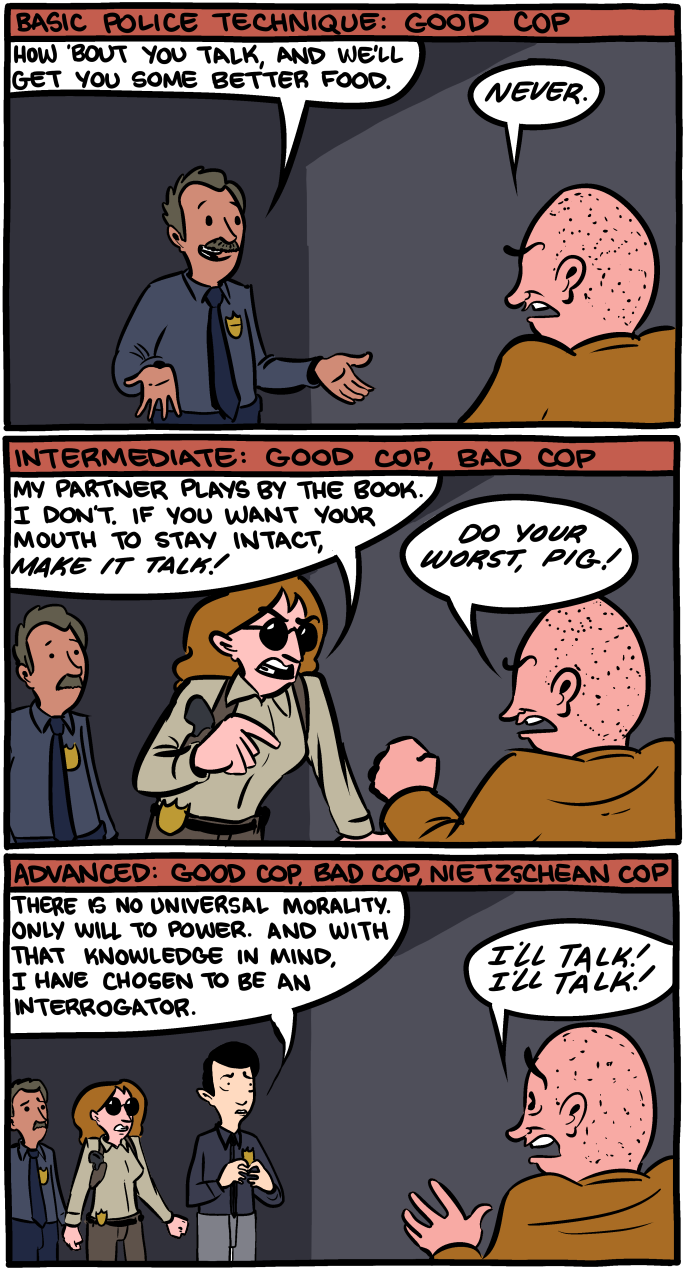
The comic shows three levels of police interrogation technique. In the first panel, labeled "Basic: Good Cop / Bad Cop," a friendly officer tells the suspect to talk and offers to get better food, while the suspect refuses. In the second panel, labeled "Intermediate: Good Cop, Bad Cop," the bad cop threatens the suspect while the good cop plays along, and the suspect defiantly asks "Do your worst, pig!" In the third panel, labeled "Advanced: Good Cop, Bad Cop, Nietzschean Cop," a third interrogator enters who says: "There is no goodness... morality... only will to power. And with that framework in mind, I have chosen to be an interrogator." The suspect immediately agrees to talk.
The Humor
The joke escalates the classic "good cop, bad cop" interrogation trope through increasingly sophisticated levels. The punchline is that neither kindness (good cop) nor threats (bad cop) work on the suspect, but a cop who frames his role through Nietzschean philosophy -- openly admitting that he has freely chosen to be an interrogator purely as an exercise of his "will to power," unburdened by any moral framework -- is the one who terrifies the suspect into cooperating. The implication is that someone who has consciously and philosophically justified their role as a torturer, without even the pretense of moral purpose, is far more frightening than a simple bully. The comic plays on the idea that nihilistic self-awareness is more intimidating than brute force.
References
The comic references Friedrich Nietzsche's philosophical concept of the "will to power" (Wille zur Macht), which Nietzsche described as a fundamental driving force in humans -- the desire to assert and express one's strength. The "good cop, bad cop" routine is a well-known interrogation strategy in which two officers take contrasting approaches to pressure a suspect into confessing.