2014-02-04
Explanation
The Joke
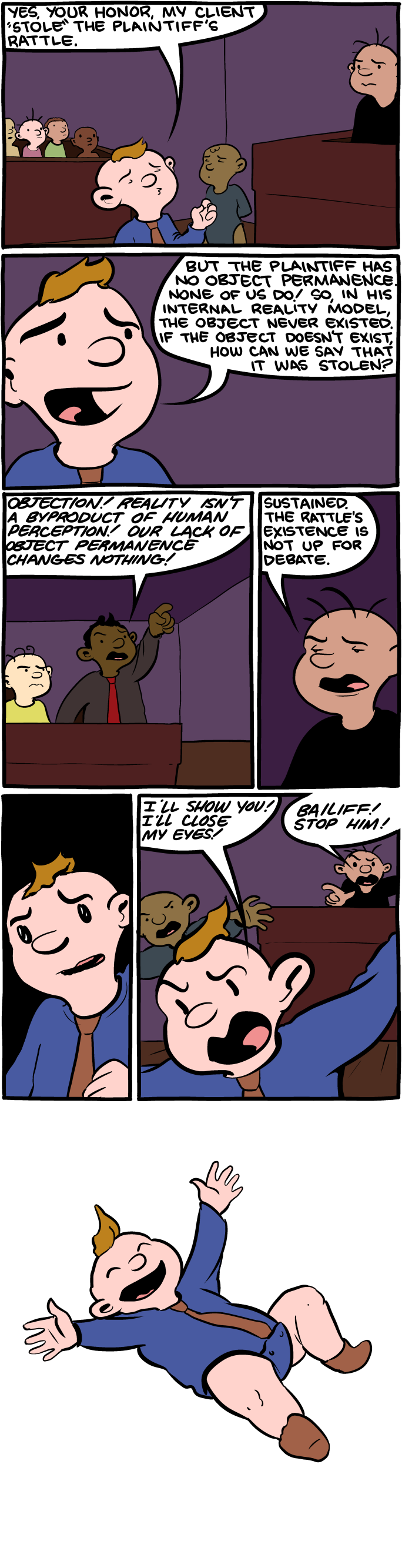
The comic depicts a courtroom scene. A defense attorney argues that his client stole a baby's rattle, but since the baby (the plaintiff) has no object permanence -- meaning babies lack the cognitive ability to understand that objects continue to exist when they cannot be seen -- the object effectively never existed in the baby's internal reality model. He asks, "How can we say that it was stolen?" The prosecutor objects, arguing that "objective reality" is not a byproduct of human perception and that the lack of object permanence does not change anything. The judge sustains the objection, ruling that the rattle's existence is not up for debate. The defense attorney then shouts "I'll show you! I'll close my eyes!" and the judge calls for the bailiff to stop him. The final panel shows the attorney lying on the ground with his eyes closed, apparently believing he has ceased to exist.
The Humor
The humor comes from taking a legitimate developmental psychology concept -- object permanence -- and absurdly applying it as a legal defense. The attorney's argument is a comedic misapplication of philosophical idealism (the idea that reality depends on perception) to a criminal case. The escalation is key: when his philosophical argument fails, the attorney doubles down by closing his own eyes, as though he himself lacks object permanence and believes that closing his eyes will make him (or the world) disappear. He is essentially regressing to the cognitive level of the infant plaintiff. The joke satirizes both convoluted legal defenses and the absurd conclusions that can arise from taking philosophical arguments about perception to their logical extremes.
References
Object permanence is a concept from developmental psychologist Jean Piaget's theory of cognitive development. Piaget found that infants younger than about 8-12 months do not understand that objects continue to exist when they are out of sight. The philosophical undertone references idealism, particularly the ideas of George Berkeley, who argued that objects only exist insofar as they are perceived ("esse est percipi" -- to be is to be perceived).