2014-03-03
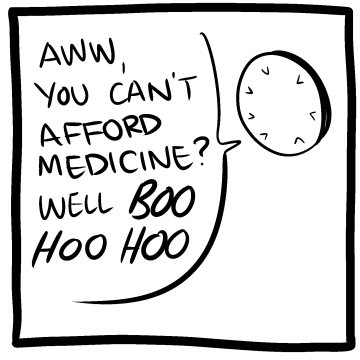
Explanation
The Joke
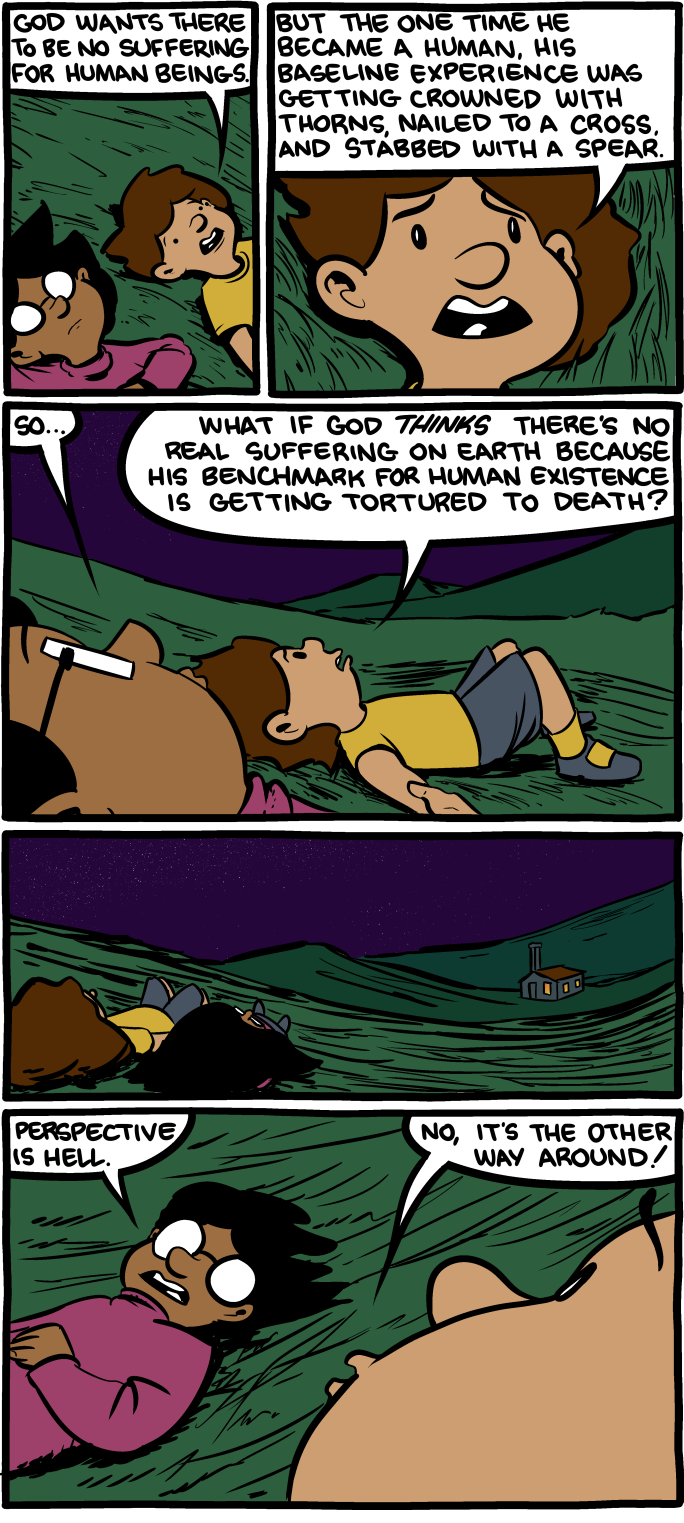
Two people are lying under the stars having a philosophical conversation. One argues that God wants there to be no suffering for human beings, but the only time God became a human (i.e., Jesus Christ), his baseline experience was "getting crowned with thorns, nailed to a cross, and stabbed with a spear." The logical conclusion: "What if God THINKS there's no real suffering on Earth, because his benchmark for human existence is getting tortured to death?" In other words, if Jesus's brief experience of being human was the worst possible suffering, then from God's perspective, everything else humans experience must seem fine by comparison. One person says "Perspective is hell," and the other corrects them: "No, it's the other way around" -- meaning hell is perspective (or rather, that the problem IS God's skewed perspective).
The Humor
The comic takes the theological concept of the Incarnation -- God becoming human in the form of Jesus -- and uses it to create a darkly logical explanation for the problem of evil (why does God allow suffering?). The joke is that God's one data point for what it is like to be human was literally the worst possible experience: crucifixion. So when humans complain about their suffering, God might think, "That's nothing compared to what I went through!" It reframes the classic theological puzzle as a simple calibration error. The wordplay at the end ("Perspective is hell" / "No, it's the other way around") adds a witty linguistic twist, suggesting that hell itself is merely a matter of (bad) perspective.
References
- The Problem of Evil (or theodicy) is the classic philosophical question of why an omnipotent, omniscient, and benevolent God would allow evil and suffering to exist in the world.
- The Incarnation refers to the Christian doctrine that God became flesh in the person of Jesus Christ, experiencing human life and ultimately crucifixion.