2014-04-15
Explanation
The Joke
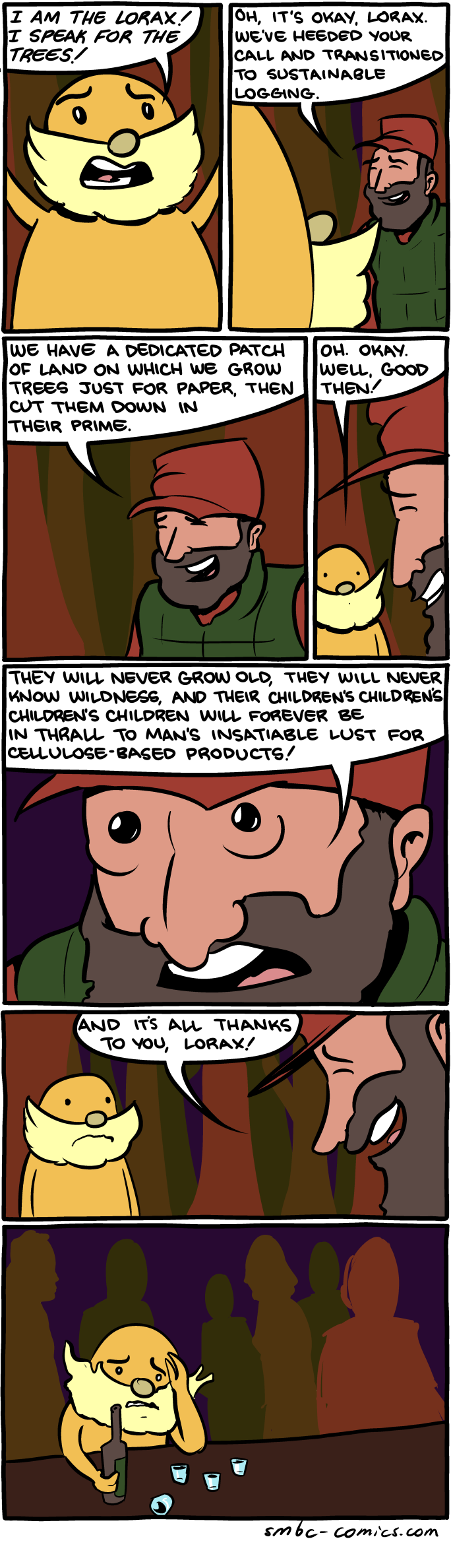
The Lorax (from Dr. Seuss) announces "I am the Lorax! I speak for the trees!" A lumberjack-like man responds calmly: "Oh, it is okay, Lorax. We heard wisdom in your call and transitioned to sustainable logging." He explains they have a dedicated patch of land where they grow trees just for paper, cutting them down "in their prime." But then he adds the dark twist: "They will never grow old. They will never know wildness. And their children's children's children's children will forever be in thrall to man's insatiable lust for cellulose-based products." The final panel shows the Lorax looking horrified as the man says, "And it is all thanks to you, Lorax!"
The Humor
The comic takes the environmentalist message of Dr. Seuss's The Lorax and twists it by imagining what "sustainable" logging actually looks like from the trees' perspective. The lumberjack has technically solved the environmental problem -- no more deforestation, sustainable tree farming -- but the solution is arguably worse for the trees on an existential level. Instead of being wild and free, trees are now perpetually farmed, never allowed to grow old or exist naturally, reduced to a domesticated crop in eternal servitude. The darkest twist is that this nightmarish tree-slavery is credited to the Lorax himself, whose advocacy inadvertently led to a system of organized, industrialized botanical subjugation rather than true liberation. It satirizes how "sustainability" can sometimes mean sustaining exploitation rather than ending it.
References
The Lorax is a 1971 children's book by Dr. Seuss about a creature who "speaks for the trees" and tries to prevent environmental destruction caused by industrial greed. The comic plays on the distinction between conservation (preserving wild nature) and sustainable resource management (efficiently farming nature for human use), a genuine tension in environmental philosophy.