2014-05-07
Explanation
The Joke
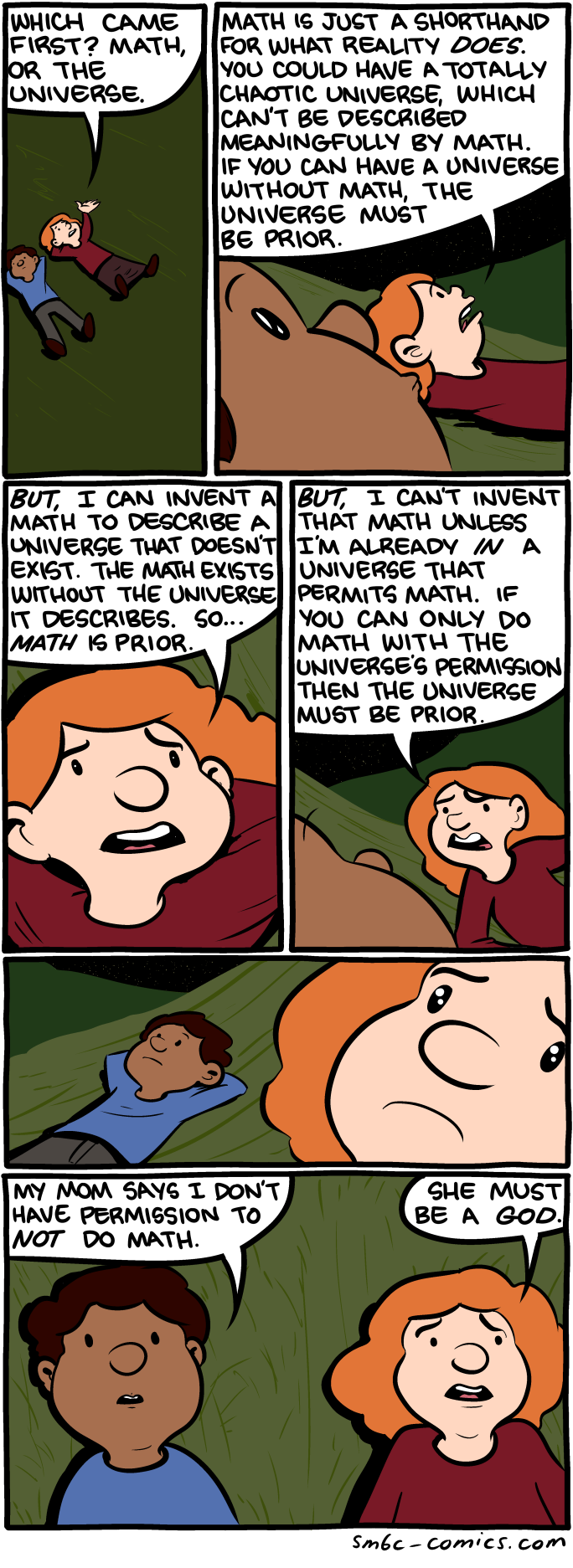
The comic explores the philosophical question of whether mathematics or the universe is more fundamental. A man lying on the ground argues that math is just a shorthand — you could have a universe without math, so the universe must be "prior" (more fundamental). Another person counters that he can invent math to describe a universe that does not exist, meaning math exists independent of the universe, so math must be prior. The first man then argues he cannot invent math unless there is already a universe that permits math — if you can only do math with the universe's permission, then the universe must be prior.
In the final panel, the man says "My mom says I don't have permission to do math," and the other person responds "She must be a god" — equating his mother's authority over his math activities with the universe's authority over the existence of mathematics.
The Humor
The comic takes a genuinely deep philosophical debate — the ontological priority of mathematics versus physical reality — and builds through increasingly sophisticated arguments before deflating the whole thing with a childish punchline. The key comedic move is the word "permission": the philosophical argument about whether the universe "permits" math gets literalized into a child not having his mother's permission to do math, making her equivalent to a god or the universe itself. The humor comes from the sudden shift from abstract metaphysics to a mundane childhood scenario, and from the absurdity of a mother forbidding math.
References
The debate in this comic reflects real positions in the philosophy of mathematics. Mathematical Platonism holds that mathematical objects exist independently of the physical world (math is prior), while mathematical nominalism and various forms of physicalism argue that mathematics is merely a human tool for describing physical reality (the universe is prior). This is related to the broader question explored by thinkers like Eugene Wigner in his famous essay "The Unreasonable Effectiveness of Mathematics in the Natural Sciences" (1960).