2014-05-26

Explanation
The Joke
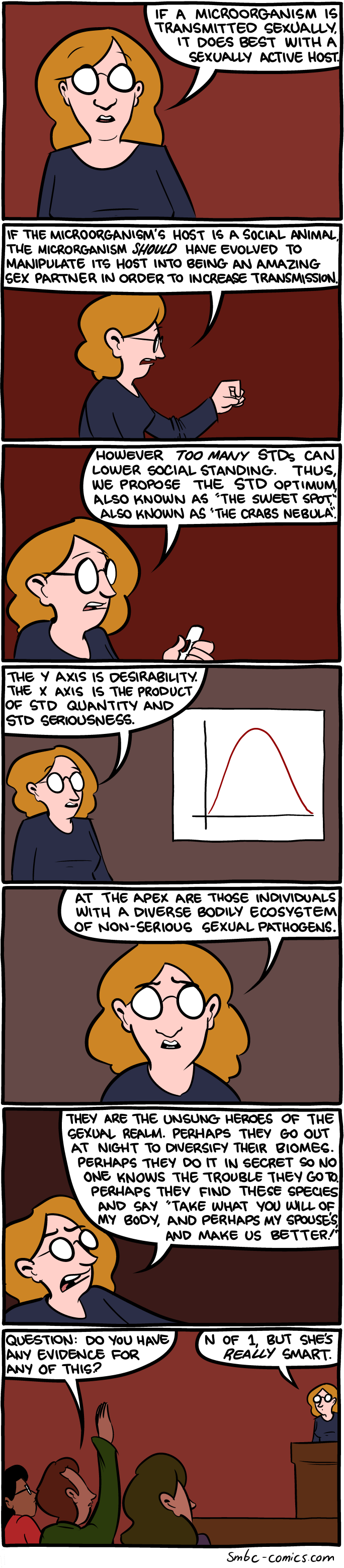
A woman gives a lecture explaining that if a microorganism is transmitted sexually, it does best with a sexually active host. Therefore, the microorganism"s genes would have evolved to manipulate its host into having more sex. She proposes that sexually transmitted infections (STIs) could cause social standing changes, like making the host more attractive. She labels this the "STD Optimum," also known as the "grass median." She explains that beyond this optimum, individuals with a diverse collection of non-dangerous sexual pathogens become the attractive, popular people at bars -- they are "the unknown heroes of the dating scene" who go out, identify desirable but single people, boost their confidence, take them home, and then leave before things get serious, thus serving as a social good. When asked if she believes any of this, she says, "No, but it makes me feel better about my life choices."
The Humor
The comic takes genuine evolutionary biology concepts -- that sexually transmitted organisms benefit from hosts who have more sexual partners -- and extrapolates them to an absurd conclusion: that having lots of STIs actually makes you more attractive and socially beneficial. The lecturer constructs an elaborate pseudo-scientific framework to reframe promiscuity and casual sex as a noble public service driven by microbial evolution. The punchline reveals the entire lecture was motivated not by scientific inquiry but by the speaker"s desire to rationalize her own lifestyle. The humor lies in using the veneer of academic rigor to construct an elaborate justification for behavior the speaker feels insecure about.
References
- Parasite manipulation of host behavior: A real phenomenon in evolutionary biology where parasites alter their host"s behavior to increase transmission. For example, Toxoplasma gondii is known to make infected rodents less afraid of cats, increasing the chance the parasite completes its life cycle.
- Sexually transmitted infections and evolution: There is genuine scientific research on how STIs evolve to maximize transmission, including theories about how they might influence host behavior.