2014-06-04
Explanation
The Joke
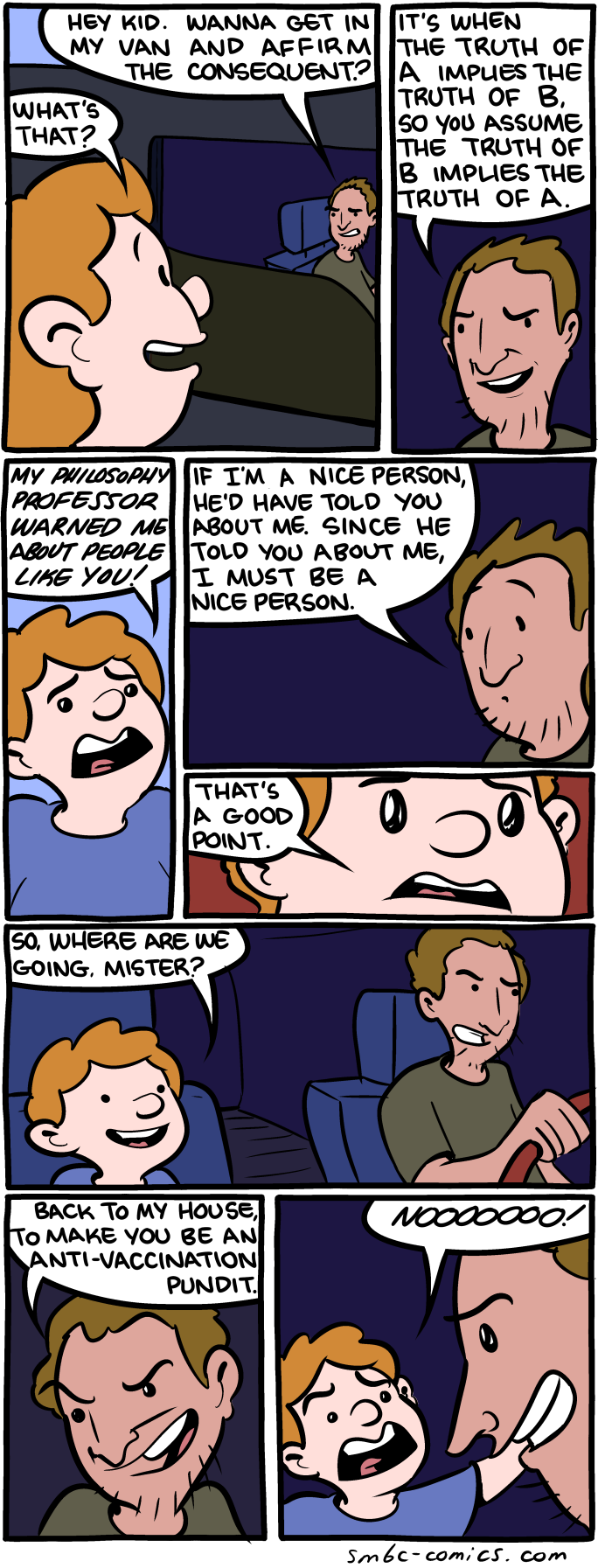
A man on a park bench invites a passerby into a conversation about logic. He explains "affirming the consequent" -- a logical fallacy where you assume that because "if A then B" is true, and B is true, then A must be true. He gives an example: "If I'm a nice person, I'd have told you about me. Since I've told you about me, I must be a nice person." The passerby agrees: "That's a good point."
The passerby then asks where they're going, and the man responds: "Back to my house, to make you be an anti-vaccination pundit." The passerby shouts "Nooooooo!"
The Humor
The comic demonstrates the logical fallacy of affirming the consequent in action. The man on the bench uses the fallacy to "prove" he is a nice person, and the passerby falls for it, not recognizing that the argument is invalid. The structure "If P then Q; Q; therefore P" is a well-known logical error -- many non-nice people also talk about themselves.
The dark twist in the punchline is that the man is actually a sinister recruiter using faulty logic to manipulate people. His goal -- turning someone into an anti-vaccination pundit -- suggests that anti-vaccination advocacy is built on similarly flawed reasoning. The comic implies that people who fall for basic logical fallacies are vulnerable to being recruited into movements built on bad logic, such as the anti-vaccination movement, which relies on fallacious reasoning like confusing correlation with causation.
References
- Affirming the consequent is a formal logical fallacy: "If P then Q; Q is true; therefore P is true." A valid form would be modus ponens: "If P then Q; P is true; therefore Q is true."
- The anti-vaccination movement has been widely criticized by scientists and medical professionals for relying on debunked studies and logical fallacies.