2014-07-12

Explanation
The Joke
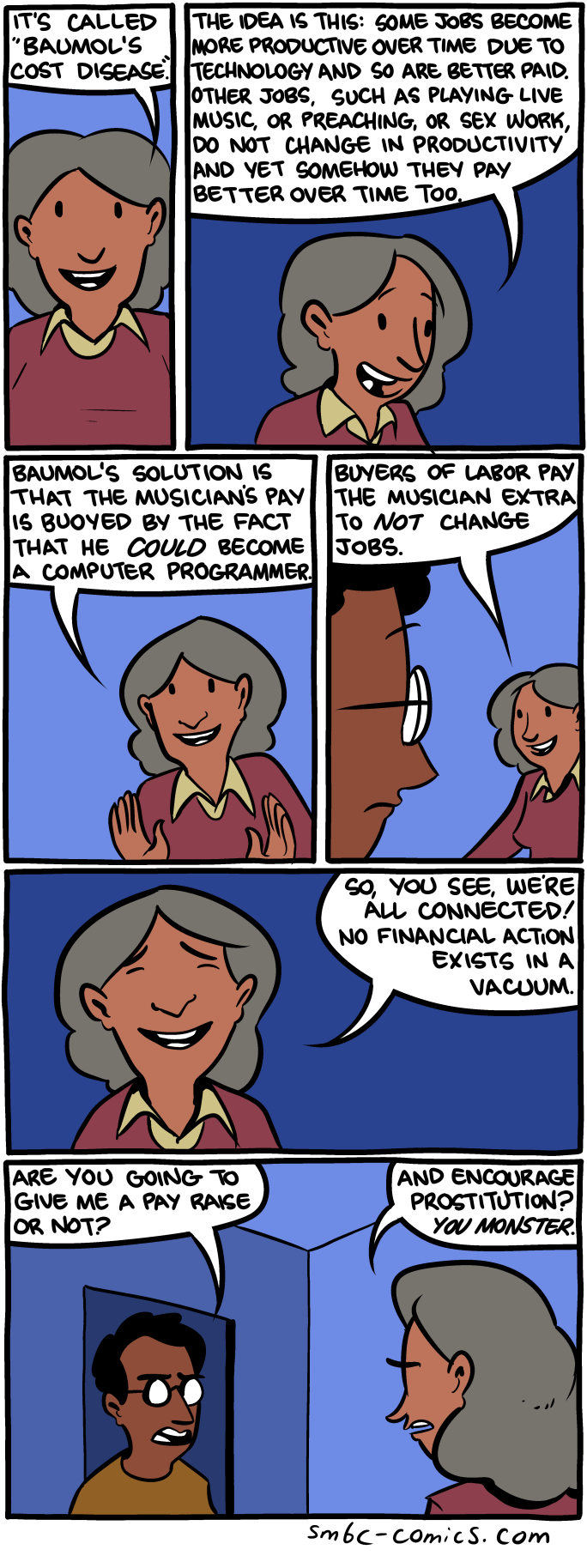
A professor is explaining Baumol's cost disease to a student. She describes how some jobs become more productive over time due to technology and thus better paid, while others (like music, preaching, or gig work) do not change in productivity and yet somehow they pay better over time too. Baumol's solution is that the musician's pay is "buoyed by the fact that he could become a computer programmer" (i.e., workers in low-productivity-growth fields must be paid competitively or they will switch to high-productivity-growth fields). The professor then adds that buyers of labor pay the musician extra "to not change jobs." She concludes: "So you see, we're all connected! No financial action exists in a vacuum." The student then asks: "Are you going to give me a pay raise or not?" and the professor responds: "And encourage productivity? You monster."
The Humor
The comic uses Baumol's cost disease as a setup for a workplace joke. The professor eloquently explains why wages rise across all sectors even when productivity does not -- a real and important economic concept. But the punchline reveals the irony: the student (presumably a teaching or research assistant) uses the professor's own logic to ask for a raise, since they too should benefit from rising wages elsewhere. The professor's refusal -- framed as not wanting to "encourage productivity" -- is a joke about how academia (and employers generally) love to teach economic theory about fair wages while being notoriously stingy with their own employees.
References
Baumol's cost disease is a real economic concept formulated by William Baumol and William Bowen in the 1960s. It explains why costs rise in sectors with little productivity growth (like the performing arts, education, and healthcare) -- because they must compete for workers with sectors that do experience productivity growth.