2014-07-27

Explanation
The Joke
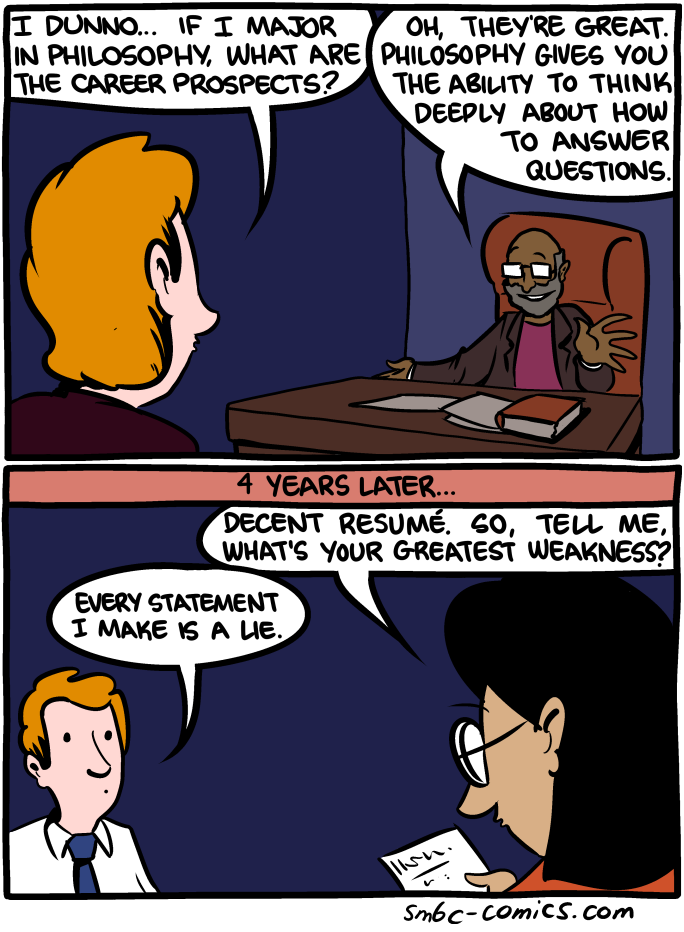
A student says, "I dunno... if I major in philosophy, what are the career prospects?" His companion enthusiastically responds: "Oh, they're great! Philosophy gives you the ability to think deeply about how to answer questions."
Cut to "4 years later": the philosophy graduate is at a job interview. The interviewer says "Decent resume. Go. Tell me, what's your greatest weakness?" The graduate, having thought deeply about questions, answers: "Every statement I make is a lie."
The Humor
The joke works on two levels. First, it satirizes the common concern about philosophy degrees having poor career prospects. The initial pitch — that philosophy teaches you to "think deeply about how to answer questions" — sounds positive but turns out to be useless in practical settings.
Second, the punchline is a classic logic paradox: "Every statement I make is a lie" is a version of the Liar's Paradox (if the statement is true, then it must be a lie, but if it is a lie, then it must be true). The philosophy graduate has learned to think so deeply about questions that he answers a simple job interview question with an unsolvable logical paradox, which is both intellectually impressive and completely unhelpful in a job interview context.
References
The Liar's Paradox (or Epimenides Paradox) is one of the oldest and most famous paradoxes in philosophy and logic, attributed to the ancient Greek philosopher Epimenides of Crete, who reportedly said "All Cretans are liars." The paradox has been studied extensively in logic, philosophy of language, and mathematics.