2014-09-17
Explanation
The Joke
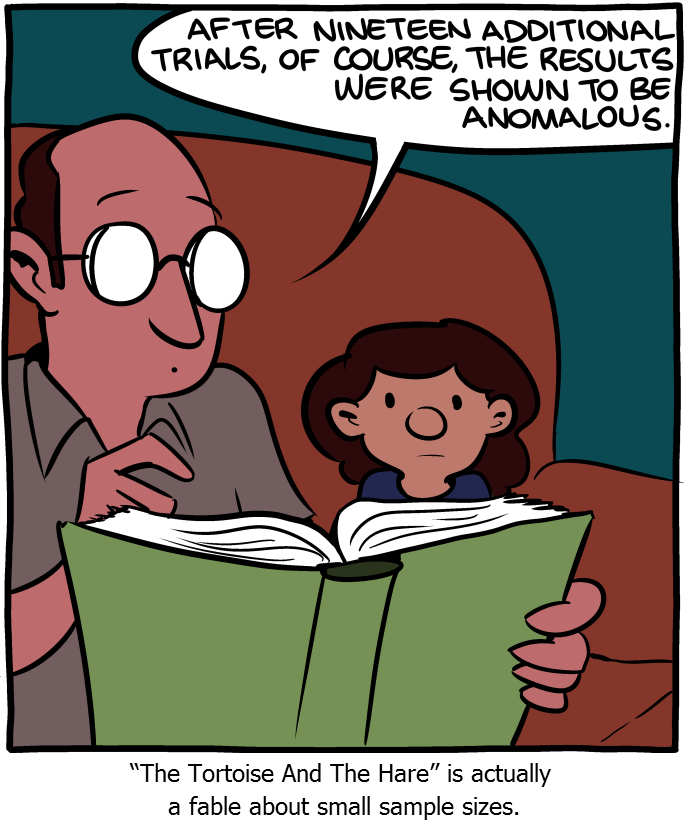
A father is reading a book to his young daughter. He says, "After nineteen additional trials, of course, the results were shown to be anomalous." The caption below reads: "'The Tortoise and the Hare' is actually a fable about small sample sizes."
The Humor
The classic Aesop's fable "The Tortoise and the Hare" tells of a race where a slow tortoise beats a fast hare because the hare is overconfident and takes a nap. The moral is traditionally about perseverance and humility. However, this comic reinterprets the story through the lens of statistics: in any single trial, an unlikely outcome can occur (the tortoise winning). But if you ran the race 19 more times (i.e., increased your sample size), the hare would almost certainly win every other time, revealing the original result to be an anomaly or statistical fluke.
The humor comes from applying rigorous scientific thinking to a children's fable, completely undermining its intended moral. Instead of "slow and steady wins the race," the real lesson becomes "don't draw conclusions from a single data point" -- a much less inspiring but more scientifically accurate takeaway.
References
- "The Tortoise and the Hare" is one of Aesop's Fables, traditionally dated to ancient Greece (circa 600 BCE).
- Small sample sizes are a well-known problem in scientific research. Results based on very few trials are unreliable because they are more susceptible to random variation and unlikely outcomes.