2014-09-23
Explanation
The Joke
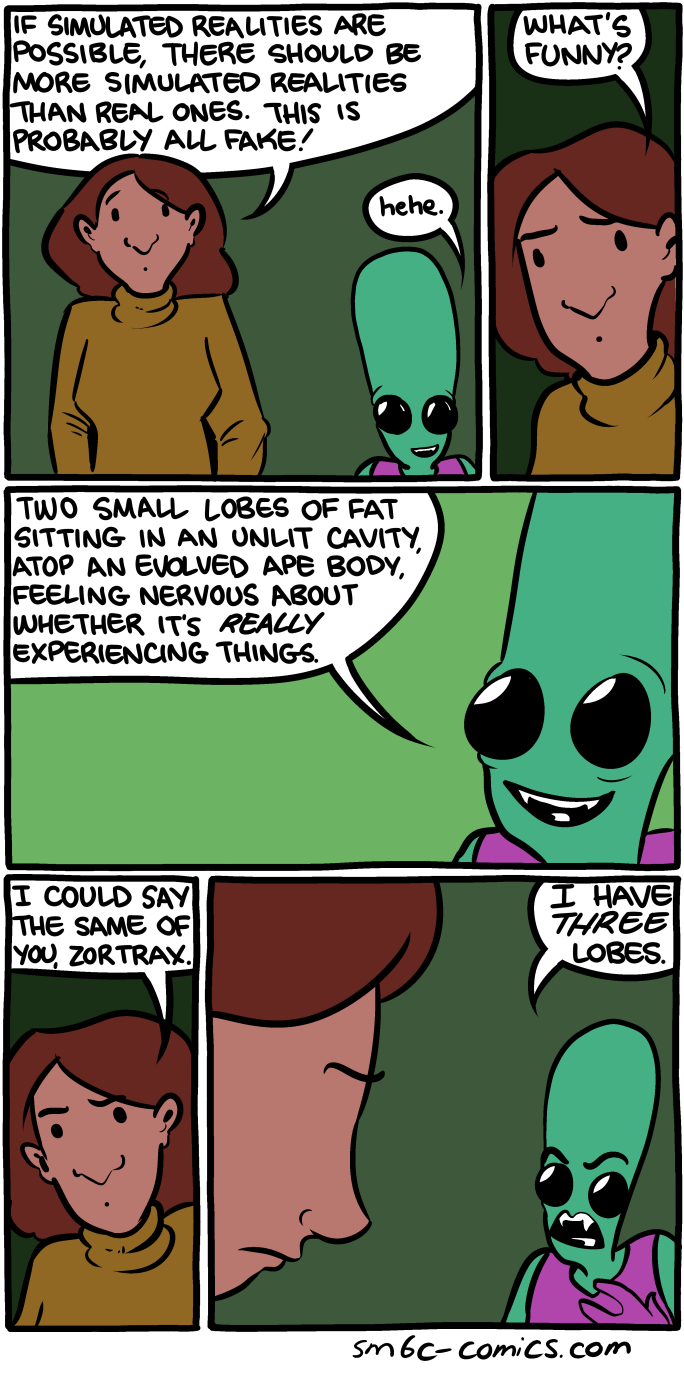
The comic opens with a woman presenting the simulation argument: "If simulated realities are possible, there should be more simulated realities than real ones. This is probably all fake." Her companion, an alien with antenna, finds this funny: "What's funny... hehe." The scene then shifts to reveal: "Two small lobes of fat sitting in an unlit cavity atop an evolved ape body, feeling nervous about whether it's 'really' experiencing things." This is a description of a human brain from an outside perspective. The alien says "I could say the same of you Zortaks" to a different alien, who responds "I have three lobes."
The Humor
The comic attacks the simulation argument by reframing it through biological reductionism. The simulation hypothesis sounds profound when discussed in philosophical terms, but the comic points out the absurdity of a brain -- literally just fat tissue sitting in a dark skull cavity on top of a primate body -- worrying about whether reality is "real." The joke is that human consciousness is already strange and arguably illusory enough without needing to invoke simulated realities. The alien perspective makes this clearer by treating human self-awareness as inherently comical. The final exchange between the two aliens ("I have three lobes") adds a light punchline suggesting that even among aliens, there is always someone ready to one-up you, and that the same reductionist critique applies universally regardless of your biology.
References
The comic references the simulation argument, most famously articulated by philosopher Nick Bostrom in his 2003 paper "Are You Living in a Computer Simulation?" The argument posits that if civilizations can create realistic simulations, then statistically we are more likely to be in a simulation than in base reality.