2014-09-27
Explanation
The Joke
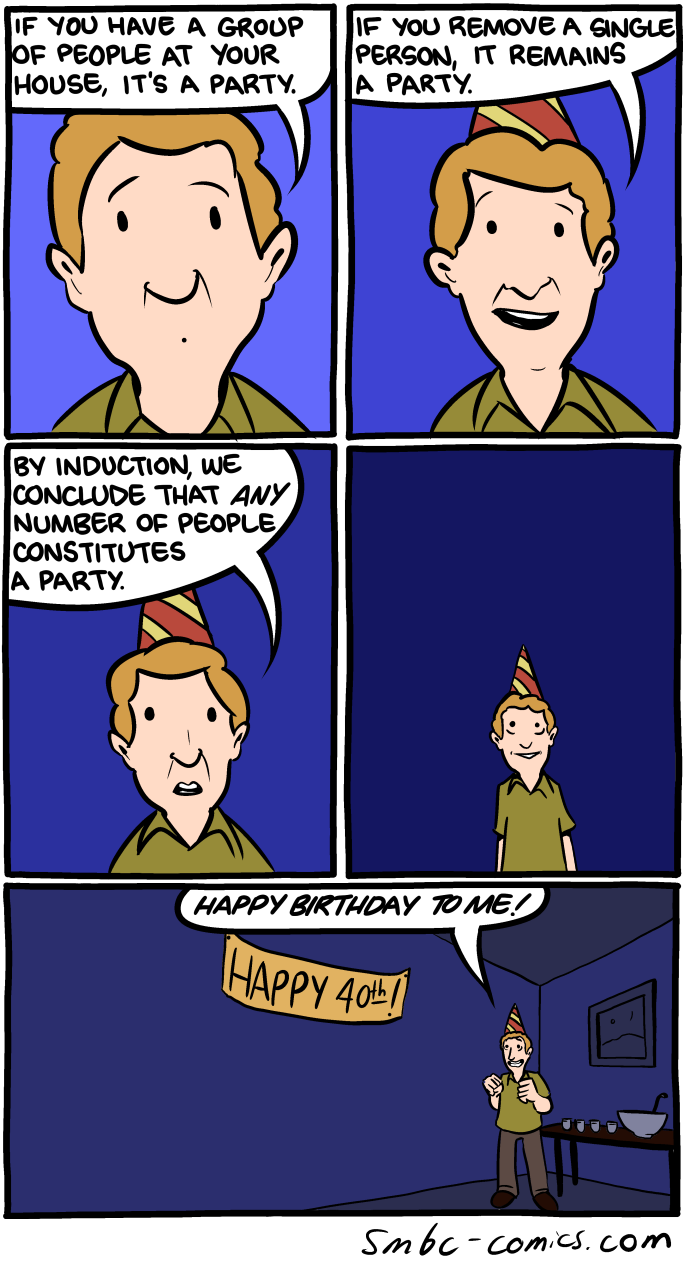
A man presents what appears to be a mathematical proof by induction. He starts with the premise: "If you have a group of people at your house, it's a party." Then he adds: "If you remove a single person, it remains a party." He concludes: "By induction, we conclude that any number of people constitutes a party." The final panel shows him alone in a dark room with a birthday banner and a single cupcake, sadly declaring "Happy birthday to me" and "Happy 40th" -- using his "proof" to justify that his solo gathering counts as a party.
The Humor
The comic is a math joke built on a deliberate misuse of mathematical induction. Proper induction requires a base case and an inductive step; here, the base case ("a group of people is a party") is vague, and the inductive step ("removing one person still leaves a party") seems reasonable but leads to the absurd conclusion that even zero or one person constitutes a party. This is actually a well-known logical paradox similar to the Sorites paradox (the "paradox of the heap" -- if you remove one grain of sand from a heap, it is still a heap, so by induction, one grain is a heap). The emotional punchline is that this seemingly abstract logical exercise is really just a lonely man trying to rationalize his solitary 40th birthday as a real party. The contrast between the confident logical presentation and the sad reality makes it both funny and poignant.
References
The comic references proof by mathematical induction, a fundamental technique in mathematics. It also parallels the Sorites paradox (heap paradox), attributed to the ancient Greek philosopher Eubulides of Miletus, which explores how vague predicates break down under iterative small changes.