2014-10-09
Explanation
The Joke
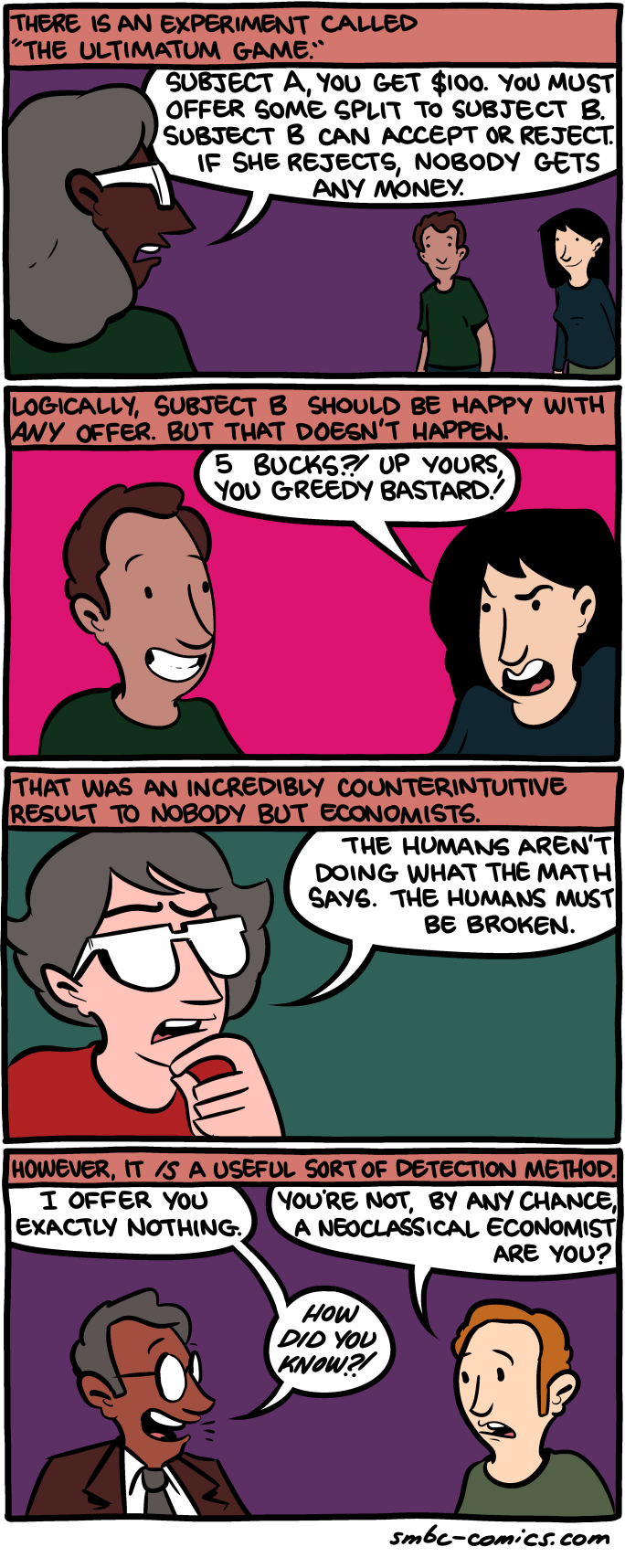
A person explains the Ultimatum Game to another: Subject A receives $100 and must offer some split to Subject B. Subject B can accept or reject the offer. If Subject B rejects, nobody gets any money. Logically, Subject B should accept any offer, since even $1 is better than nothing. But in practice, people reject offers they perceive as unfair. The example shows Subject B rejecting a low offer and saying "5 bucks?! Of yours, you greedy bastard!"
The narrator notes this was "an incredibly counterintuitive result" and that researchers concluded "the humans must be broken" -- that humans are not acting as rational economic agents. However, the comic then flips the script: it suggests the Ultimatum Game is actually a useful tool for detecting something else entirely. In the final panel, a person offers another "exactly nothing" and asks "You're not, by any chance, a neoclassical economist, are you?" -- implying that only a neoclassical economist (who models humans as perfectly rational utility maximizers) would accept such an absurdly unfair offer.
The Humor
The humor works by inverting the typical framing of the Ultimatum Game. In economics, the "irrational" behavior of rejecting unfair offers is treated as a puzzle or a flaw in human reasoning. The comic flips this by suggesting that the truly irrational person would be someone who accepts any offer no matter how insulting -- and that such a person could only be a neoclassical economist, since only they actually believe in the model of purely rational self-interest. The punchline turns the Ultimatum Game from a test of human irrationality into a test for detecting economists, treating the economic model itself as the aberration rather than human behavior.
References
The Ultimatum Game is a well-known experiment in behavioral economics, first proposed by Werner Guth, Rolf Schmittberger, and Bernd Schwarze in 1982. It demonstrated that people routinely reject offers they consider unfair, even at a cost to themselves, contradicting the predictions of classical game theory and rational choice theory. The comic satirizes neoclassical economics and its assumption of Homo economicus -- the perfectly rational, self-interested agent.