2014-10-20
Explanation
The Joke
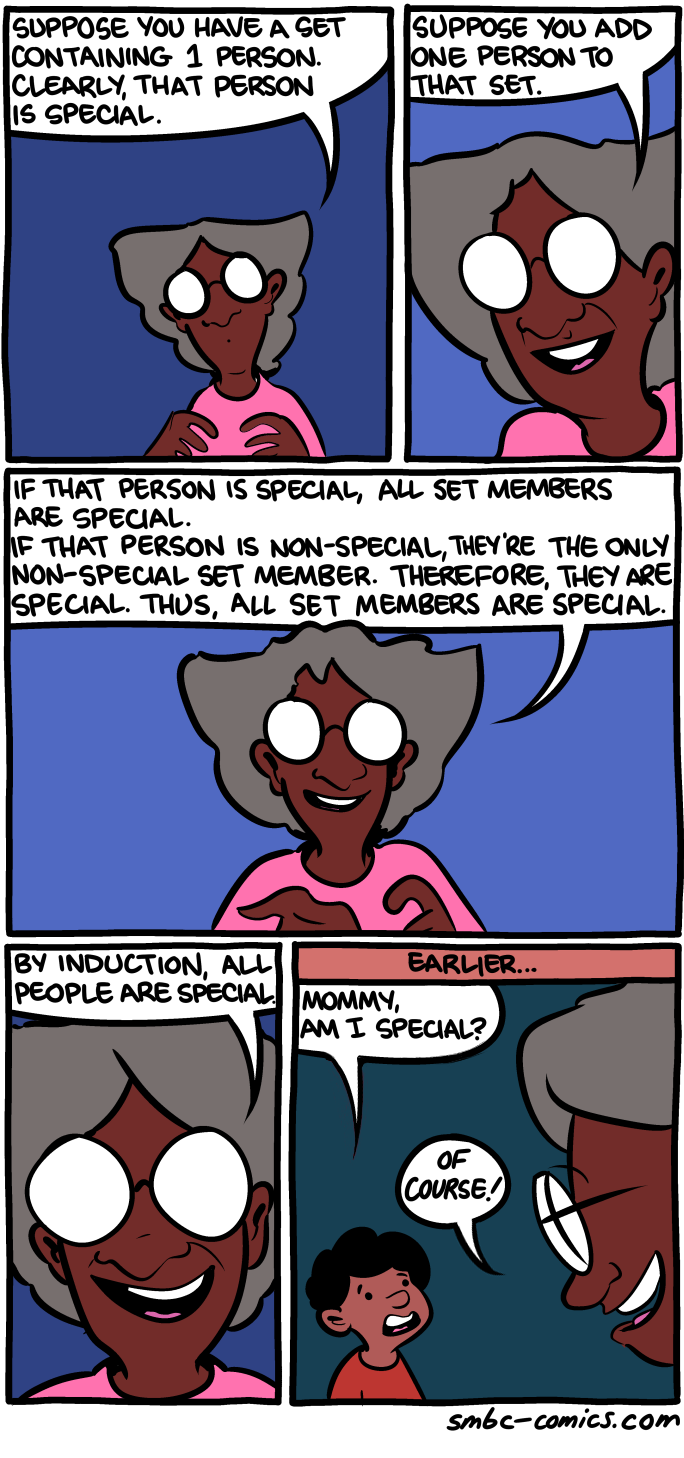
A teacher presents a mathematical induction argument to prove that "all people are special." The setup: suppose you have a set containing one person -- clearly that person is special. Now add one more person. If the new person is special, then all set members are special. If the new person is not special, they are the only non-special member, which makes them unique, and therefore special. By induction, all people are special. The comic then cuts to a child asking her mother "Mommy, am I special?" and the mother enthusiastically replying "Of course!" -- but this is labeled "Earlier," implying the mother'''s reassurance is what motivated the teacher to construct this dubious proof.
The Humor
The comic parodies mathematical induction proofs by using the structure of a legitimate mathematical argument to "prove" something that is essentially a feel-good platitude. The induction step contains a deliberate logical fallacy: claiming that being the only non-special person in a group makes you special confuses "unique" with "special" and does not actually follow from any rigorous definition. The joke is that this is the kind of reasoning a loving parent might use -- and indeed the final panel reveals that the whole proof was apparently inspired by a mother'''s desire to tell her child she is special. The comic gently mocks how people use the trappings of logic and mathematics to justify conclusions they have already decided on emotionally.
References
Mathematical induction is a proof technique used to establish that a statement holds for all natural numbers. It consists of proving a base case and then proving that if the statement holds for some number n, it also holds for n+1. The comic'''s "proof" mimics this structure but introduces a logical error in the inductive step.