2014-11-05
Explanation
The Joke
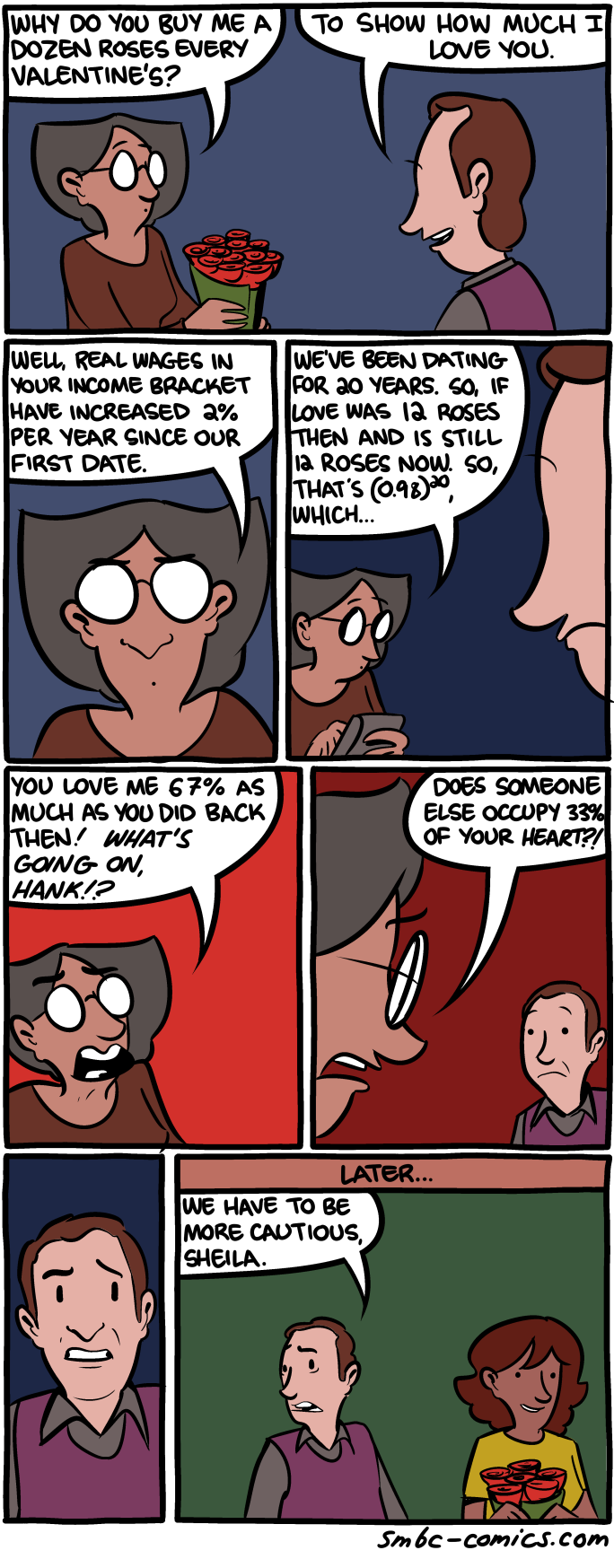
A woman asks a man why he buys her a dozen roses every Valentine's Day. He says it is to show how much he loves her. She then applies economic reasoning: real wages in their income bracket have increased 3% per year since their first date, and they have been dating for 30 years. So if love was 12 roses then, and is still 12 roses now, adjusting for inflation, he actually loves her only 0.7% as much as he did back then -- since the roses have not kept pace with his increased purchasing power.
The man is devastated: "You love me 0.7% as much as you did back then? What is going on?" The woman tries to reassure him: "Does someone else occupy 99% of your heart?"
In the final panel, labeled "Later...", two people (possibly friends or colleagues of the couple) say "We have to be more cautious, Sheila" -- implying they are secret lovers, and the woman's economic analysis of the roses was actually a deflection or an attempt to guilt the man, while she herself is being unfaithful.
The Humor
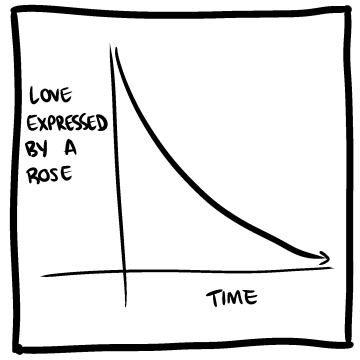
The comic satirizes what happens when you apply cold economic analysis to romantic gestures. The idea that a consistent gift should scale with income to maintain the same emotional signal is both logically sound (from an economics perspective) and emotionally absurd (from a relationship perspective). The humor comes from the gap between how economists think about value and how normal people think about love.
The twist ending adds a dark comedic layer -- the woman who was so analytically scrutinizing her partner's devotion turns out to potentially be the one who is unfaithful, making her entire economic argument either a projection of guilt or a deliberate manipulation tactic.
References
The comic references the economic concept of real wages versus nominal wages and inflation adjustment. It also plays on the idea of "revealed preferences" in economics -- the notion that what people actually spend (rather than what they say) reveals their true values.