2014-11-17
Explanation
The Joke
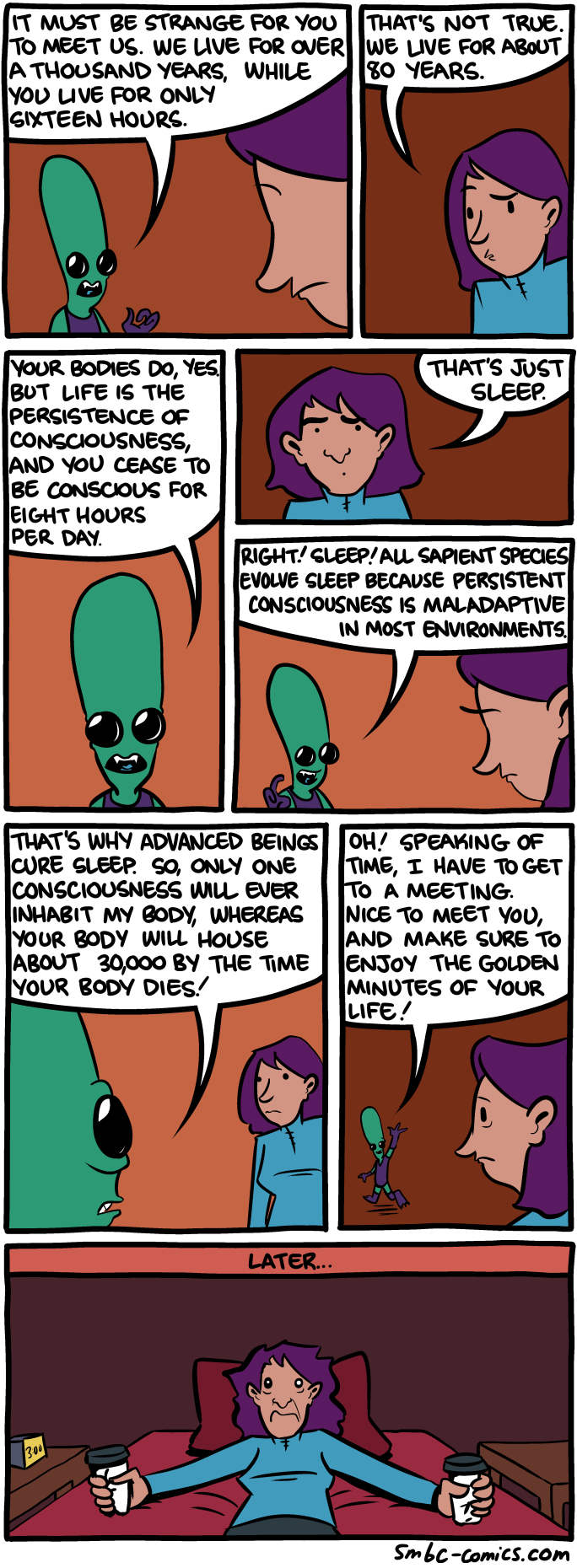
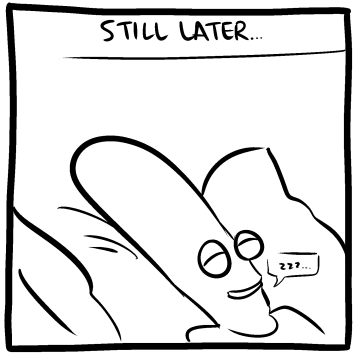
An alien tells a human couple that it must be strange for humans, who live for about a thousand years, to meet aliens that only live for sixteen hours. The humans correct the alien: they actually live for only about 80 years. The alien counters that human bodies do live longer, but the important part of life is the persistence of consciousness, and humans cease to be conscious for about eight hours per day. The alien explains that sleep exists because persistent consciousness is maladaptive in most environments, and that advanced beings cure sleep so that only one consciousness inhabits a body. The alien concludes by saying it is nice to meet them, and they should enjoy the "golden minutes" of their life. In the final panel, labeled "Later," the couple is lying in bed, and one of them is staring wide-eyed at the ceiling, unable to sleep, disturbed by the implication that each time they sleep, their consciousness dies and a new one takes its place.
The Humor
The comic takes the mundane act of sleeping and reframes it as an existential horror. The alien's perspective forces the humans to confront an unsettling philosophical idea: if consciousness is interrupted every time you sleep, are you really the same person when you wake up? The alien casually implies that each sleep cycle effectively ends one consciousness and begins another, meaning a human's "real" lifespan is not 80 years but just the waking hours of a single day. The final panel is the payoff -- the human is now too disturbed to sleep, which is both funny and relatable, as the comic has essentially given the reader the same existential anxiety.
References
- The philosophical question of personal identity and continuity of consciousness has been debated since antiquity. Thinkers like John Locke argued that personal identity depends on continuity of consciousness, raising questions about whether the "you" that wakes up is the same "you" that fell asleep.
- The idea that sleep might represent a discontinuity in consciousness relates to thought experiments like the teleporter paradox (or "Ship of Theseus"), which asks whether a person who is destroyed and perfectly reconstructed is the same person.