2014-11-20
Explanation
The Joke
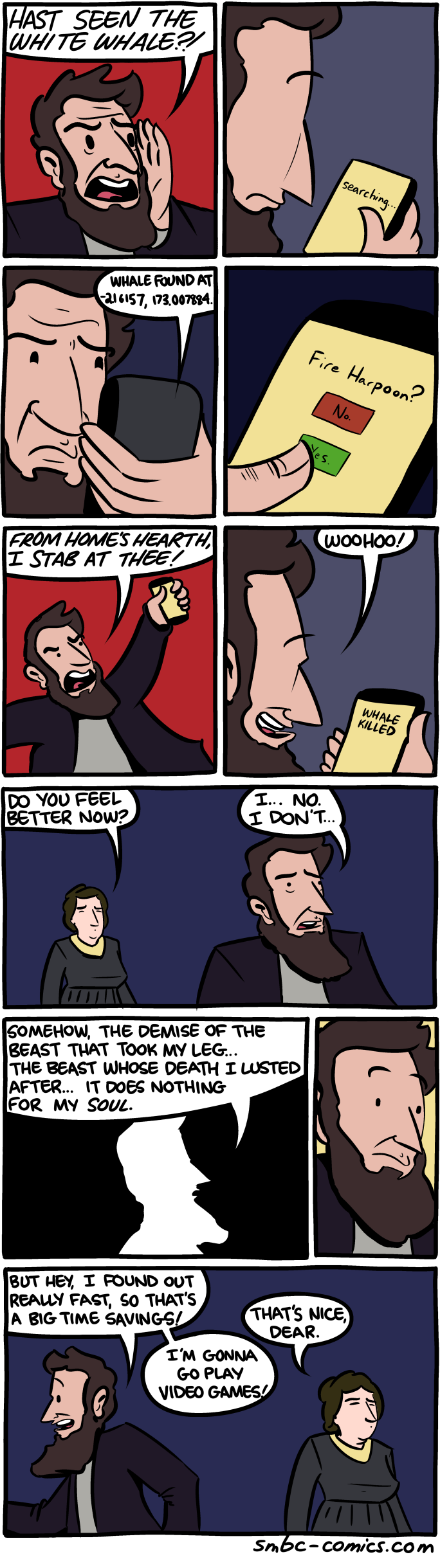
Captain Ahab (from Moby-Dick) asks "Hast seen the white whale?" A sailor checks his phone and shows him GPS coordinates and what appears to be a coupon or deal notification: "Fire Harpoons?" Ahab exclaims "Woohoo!" and the whale is quickly found and killed. But when asked if he feels better now, Ahab admits: "I... No. No I don't." He reflects that somehow the demise of the beast that took his leg -- the beast whose death he lusted after -- does nothing for his soul. But then he perks up: "But hey, I found out about RealtyFacts, so that's a big-time savings!" His wife responds "That's nice, dear" as Ahab announces he is going to go play video games.
The Humor
The comic transplants the epic literary quest of Moby-Dick into the modern age of smartphones and apps. Ahab's obsessive, years-long hunt for the white whale -- one of literature's great explorations of monomaniacal revenge -- is reduced to a trivial task accomplished in seconds via a phone app. The real joke is the anticlimax: when the whale is found and killed effortlessly, Ahab discovers that the revenge he dedicated his life to provides no satisfaction whatsoever. This is actually the thematic core of Melville's novel played for laughs -- the futility of obsessive revenge. But the comic adds a modern twist: having lost his life's purpose, Ahab immediately replaces it with the shallow comforts of modern consumer life -- savings apps and video games. The contrast between the grand existential emptiness of achieved revenge and the banal distractions of modern life is the heart of the humor.
References
- Moby-Dick (1851) by Herman Melville is the classic American novel about Captain Ahab's obsessive quest to kill the white whale that bit off his leg. The novel is widely read as an allegory about the destructive nature of obsession and revenge.
- "From hell's heart I stab at thee" is one of Ahab's most famous lines from the novel, referenced in the comic.