2014-11-27

Explanation
The Joke
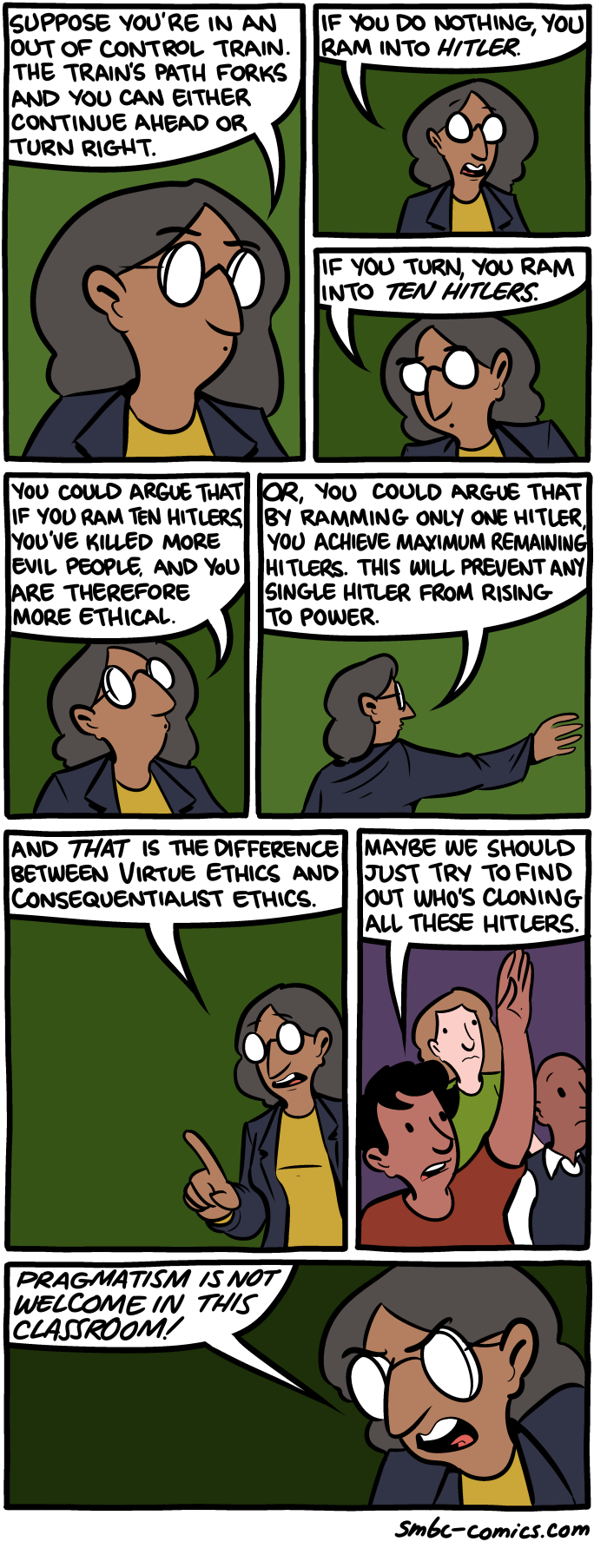
The comic presents a version of the famous "trolley problem" in ethics, but with Hitlers. A professor explains: "Suppose you're in an out-of-control train. The tracks path forks and you can either continue ahead or turn right. If you do nothing, you ram into Hitler. If you turn, you ram into ten Hitlers."
The professor then explains two ethical frameworks:
- Utilitarian ethics: You could argue that ramming ten Hitlers kills more evil people, therefore doing more good.
- Consequentialist ethics: You could argue that ramming only the single Hitler achieves maximum remaining evil prevention, since that single Hitler will presumably rise to power, whereas the ten Hitlers would compete with each other and be less effective.
A student then interjects with the practical question: "Maybe we should just try to find out who's cloning all these Hitlers." The professor dismisses this as "Pragmatism is not welcome in the classroom!"
The Humor
The comic satirizes how academic philosophy can become so absorbed in constructing elaborate thought experiments that it loses sight of practical concerns. The trolley problem is already a famously abstract ethical dilemma, and replacing the victims with cloned Hitlers makes it even more absurd. The student's common-sense suggestion -- that the real problem is someone cloning Hitlers -- is the obviously correct response, but it's rejected because it doesn't engage with the theoretical framework. This mirrors a real tension in philosophy between abstract ethical theorizing and practical problem-solving. The joke also plays on the internet's frequent invocation of Hitler in debates (see: Godwin's Law).
References
- The Trolley Problem: A classic thought experiment in ethics, originally proposed by philosopher Philippa Foot, about whether it is moral to divert a trolley to kill one person in order to save five.
- Utilitarianism vs. Consequentialism: Two related ethical frameworks. Utilitarianism (associated with Jeremy Bentham and John Stuart Mill) judges actions by their outcomes in terms of maximizing overall well-being. Consequentialism is the broader category holding that the morality of an action is determined by its consequences.
- Godwin's Law: The internet adage that as an online discussion grows longer, the probability of a comparison involving Hitler approaches 1.