2014-12-06

Explanation
The Joke
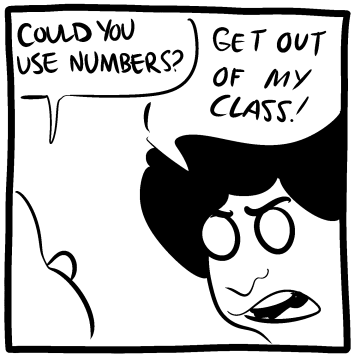
A teacher stands in front of a classroom and says, "The way the book teaches this is dumb. It'll be wayyyy simpler if we just think in terms of ordered pairs, each belonging to a nonzero commutative ring having the following allowed operations." Below the panel is a graph with "Math Knowledge" on the x-axis and "Ability to Explain Fractions" on the y-axis, showing a curve that drops sharply -- the more math you know, the worse you are at explaining fractions.
The Humor
The joke captures a well-known irony in education and expertise: the more deeply someone understands a mathematical concept, the harder it becomes for them to explain it simply to beginners. The teacher thinks she is simplifying fractions by reframing them in terms of abstract algebra (ordered pairs in commutative rings), but this is vastly more complicated for elementary students than just saying "a fraction is one number divided by another." The graph drives the point home visually -- there is an inverse relationship between mathematical sophistication and the ability to explain basic concepts like fractions. This is related to the "curse of knowledge" cognitive bias, where experts forget what it was like to not understand something and accidentally make explanations far more complex than necessary.
References
- A commutative ring is an algebraic structure studied in abstract algebra. Fractions can indeed be formally constructed as equivalence classes of ordered pairs in an integral domain (a type of commutative ring), but this formalization is wildly inappropriate for teaching basic arithmetic.
- The curse of knowledge is a cognitive bias where someone who is highly knowledgeable about a topic has difficulty imagining what it is like to lack that knowledge, making their explanations unhelpfully complex.