2014-12-25
Explanation
The Joke
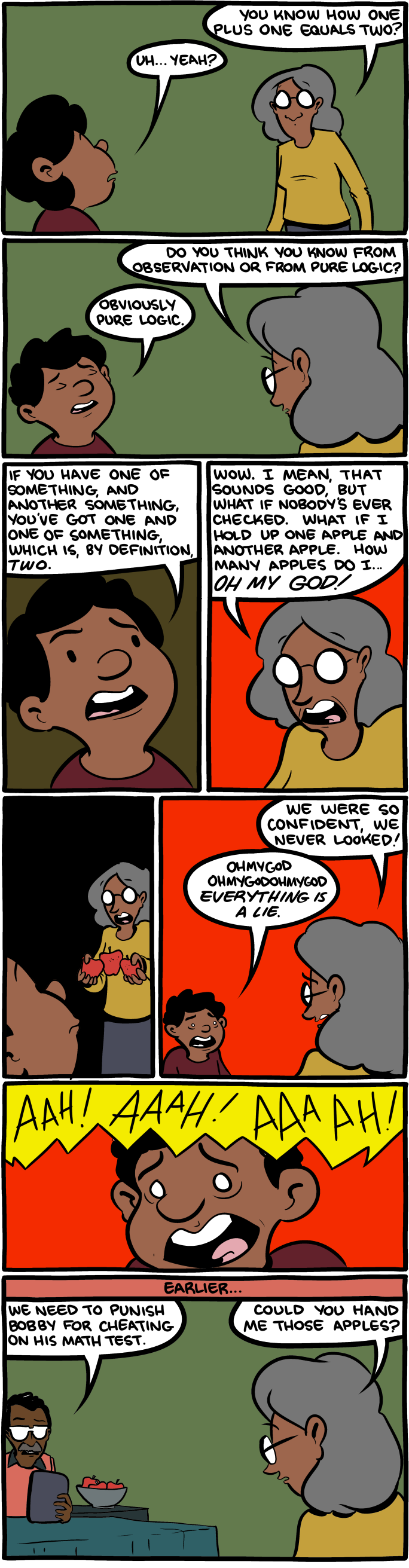
A woman asks a man if he knows that one plus one equals two. He says yes. She then asks whether he knows this from observation or from pure logic, and he confidently says "obviously pure logic." She then challenges him: what if he held up one apple and another apple and somehow got a different number? He is initially confident, but then becomes increasingly panicked -- "OH MY GOD" -- realizing he has never actually verified the claim empirically. The two of them spiral into an existential crisis, screaming "AAH!" and concluding that "obviously our understanding of everything is a lie!" In the final panel, they decide they need to "punish Berkeley for creating this with effect" and ask for apples (presumably to test the hypothesis), while a small figure (possibly George Berkeley) looks on.
The Humor
The comic dramatizes a genuine tension in the philosophy of mathematics: do we know mathematical truths a priori (through pure reason) or a posteriori (through experience)? The man confidently claims pure logic, but when challenged with a simple empirical scenario -- what if combining apples gave an unexpected result? -- he panics completely instead of calmly reasoning through it. The humor lies in the characters treating an introductory philosophy-of-math question as a world-shattering revelation and having a full emotional breakdown over it. The reference to punishing Berkeley adds a layer, since George Berkeley was a philosopher who questioned the foundations of empirical knowledge.
References
- George Berkeley (1685-1753): An Irish philosopher known for his idealism -- the view that material objects exist only as perceptions in the mind. His skepticism about the foundations of knowledge is precisely the kind of thinking that drives the characters to panic.
- A priori vs. a posteriori knowledge: The central philosophical distinction in the comic. A priori knowledge is known through reason alone; a posteriori knowledge requires sensory experience. Whether mathematical truths are a priori is a major topic in epistemology.