2015-01-10
Explanation
The Joke
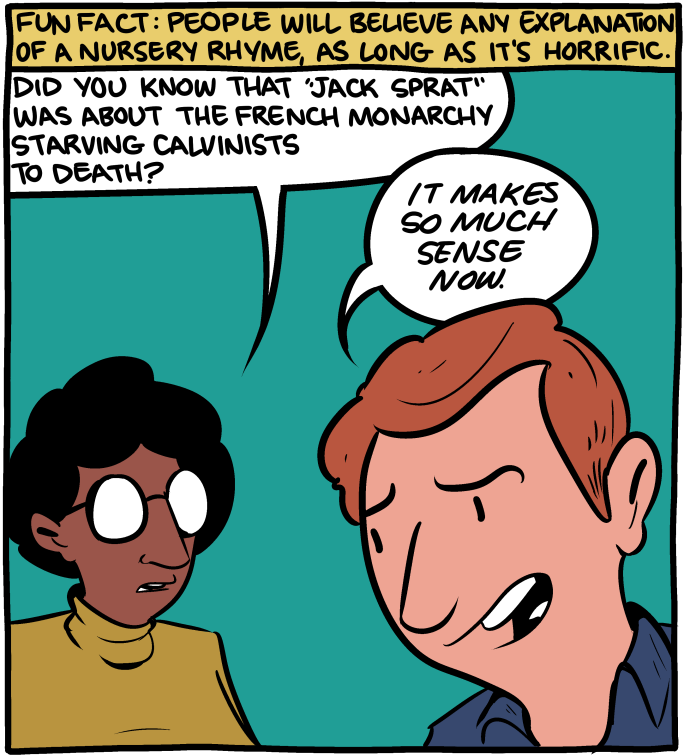
The comic opens with the text: "Fun fact: People will believe any explanation of a nursery rhyme, as long as it''s horrific." A person then tells their companion: "Did you know that ''Jack Sprat'' was about the French monarchy starving Calvinists to death?" The listener enthusiastically responds: "It makes so much sense now!"
The Humor
The joke targets the popular tendency to accept dark, gruesome "hidden meanings" behind innocent nursery rhymes without any skepticism. There is a widespread genre of folk-etymology claims that nursery rhymes like "Ring Around the Rosie" (supposedly about the plague) or "Mary Mary Quite Contrary" (supposedly about Bloody Mary''s executions) encode secret historical horrors. Many of these explanations are dubious or outright fabricated, but people eagerly believe them because the contrast between the innocent surface and the dark backstory feels satisfying and revelatory.
The comic demonstrates this by inventing a completely fake explanation for "Jack Sprat" -- connecting it to French religious persecution of Calvinists -- and showing the listener immediately accepting it with enthusiasm. The listener''s "It makes so much sense now!" is the key joke: there is nothing about "Jack Sprat could eat no fat" that connects to Calvinism or the French monarchy, but the listener is so primed to accept horrific explanations of nursery rhymes that they find the connection convincing anyway.
References
"Jack Sprat" is a traditional English nursery rhyme: "Jack Sprat could eat no fat / His wife could eat no lean / And so between the two of them / They licked the platter clean." Calvinists were followers of the Protestant reformer John Calvin, who faced persecution in Catholic France during the 16th century.