2015-01-14

Explanation
The Joke
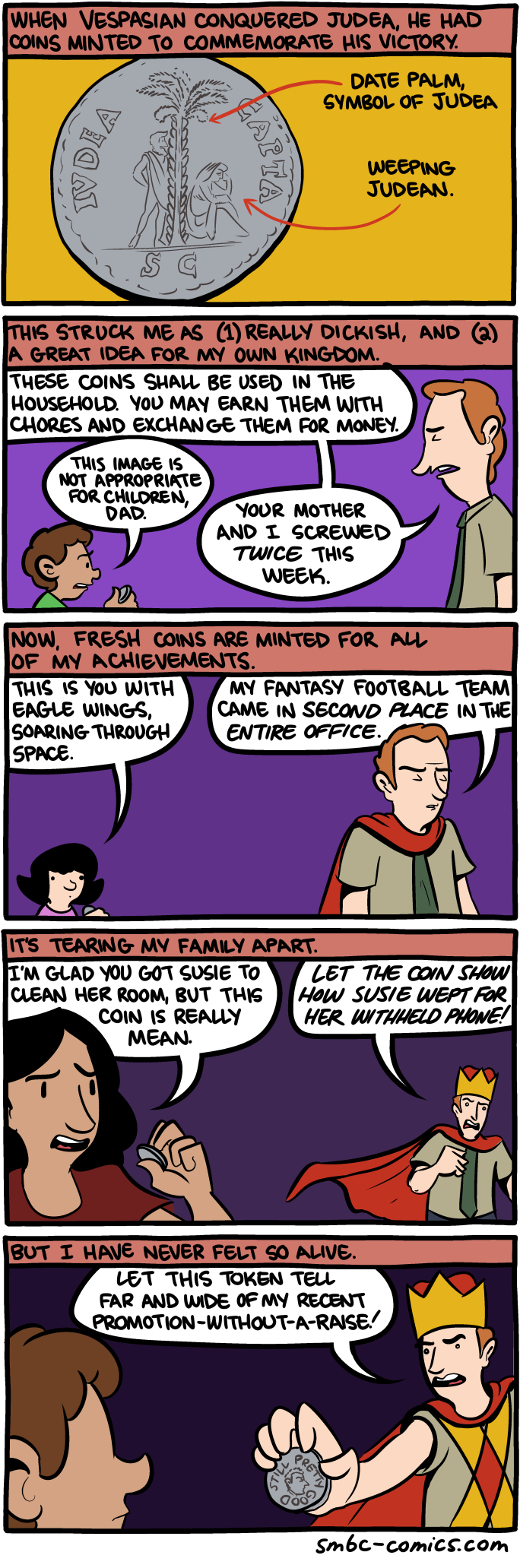
The comic begins with a historical fact: when the Roman Emperor Vespasian conquered Judea, he minted coins to commemorate his victory, featuring a date palm (symbol of Judea) and a "Weeping Judean." The narrator observes that this struck him as "(1) really dickish, and (2) a great idea for my own kingdom."
He then imagines a modern kingdom where coins are minted for all kinds of petty personal achievements and insults. Examples include: coins declaring "Your mother and I screwed three times this week," another noting "this image is not appropriate for children," a fantasy football boast ("My fantasy football team came in second place in the entire office"), a passive-aggressive parenting coin ("I''m glad you got Susie to clean her room but this coin is really mean" / "Let the coin show how Susie wept for her divorced family"), and finally a workplace coin celebrating a promotion without a raise.
The Humor
The humor works by taking the genuinely cruel historical practice of minting coins to humiliate conquered peoples and extending it to modern pettiness. Vespasian''s coins were instruments of imperial propaganda and subjugation -- depicting a weeping captive on official currency is an extraordinary act of psychological warfare. The comic imagines what would happen if ordinary people had the same power to immortalize their petty victories, grudges, and boasts on legal tender.
The escalating examples move from crude (sexual boasting), to absurd (fantasy football), to genuinely mean-spirited (a coin commemorating a child''s distress over her parents'' divorce). The final coin -- celebrating a promotion that came without a raise -- adds a note of sad irony, as the person is so desperate for recognition that they will mint a coin for a hollow achievement. Each example makes the original Roman practice seem less like ancient cruelty and more like a universal human impulse: the desire to force other people to acknowledge your victories, no matter how trivial.
References
Vespasian was Roman Emperor from 69-79 AD. After the conquest of Judea and the destruction of the Second Temple in Jerusalem in 70 AD, he issued the "Judaea Capta" coins, which depicted a mourning Jewish figure beside a palm tree. These coins were widely circulated throughout the Roman Empire as propaganda celebrating the victory.