2015-01-20

Explanation
The Joke
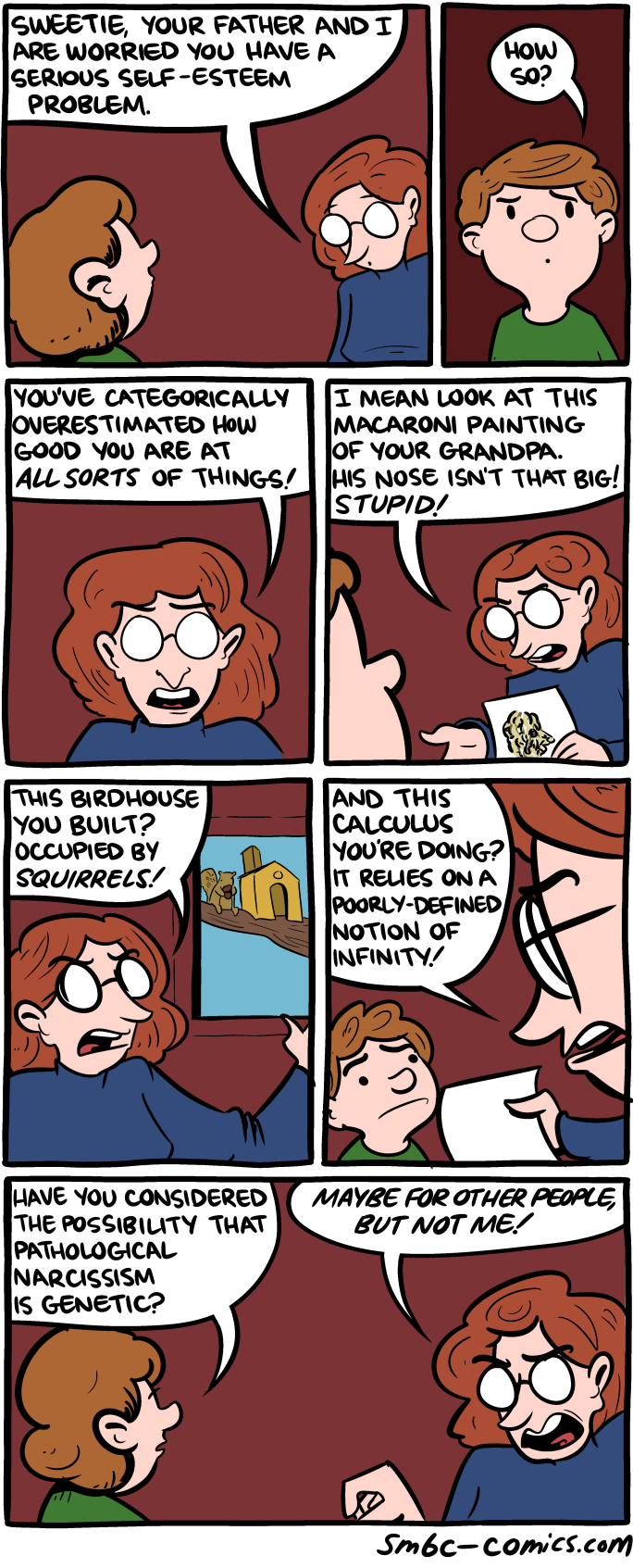
A mother tells her child that she and the father are worried the child has a serious self-esteem problem — specifically, the child has categorically overestimated how good they are at all sorts of things. The mother points out examples: a "macaroni painting" of their grandpa's nose that is not that big (implying the child thinks it is a masterpiece), a birdhouse that was occupied by squirrels, and calculus work that relies on a poorly-defined notion of infinity. The child responds, "Have you considered the possibility that narcissism is genetic?" and the mother replies, "Maybe for other people, but not me!"
The Humor
The comic works on multiple levels. On the surface, it is about parents confronting a child about overconfidence, pointing to the child's mediocre or flawed accomplishments as evidence. But the punchline reveals the true joke: the child's suggestion that narcissism might be genetic prompts the mother to dismiss the idea in a way that is itself deeply narcissistic ("Maybe for other people, but not me!"), completely oblivious to the irony. The child's narcissism clearly comes from the parents.
The humor also lies in the specificity of the examples — the calculus criticism in particular is a surprisingly sophisticated complaint for a parent to level, suggesting this is a highly educated family where even the put-downs are academically rigorous. The mention of a "poorly-defined notion of infinity" is a genuine critique in the history of mathematics, as early calculus did rely on loosely defined infinitesimals before the concept was formalized by mathematicians like Weierstrass and Cauchy.
References
The criticism about calculus relying on a "poorly-defined notion of infinity" alludes to the historical controversy around the foundations of calculus. When Newton and Leibniz developed calculus in the 17th century, their use of infinitesimals was criticized by mathematicians like Bishop Berkeley as logically incoherent. It was not until the 19th century that Cauchy, Weierstrass, and others put calculus on a rigorous footing using limits rather than infinitesimals.