2015-02-01
Explanation
The Joke
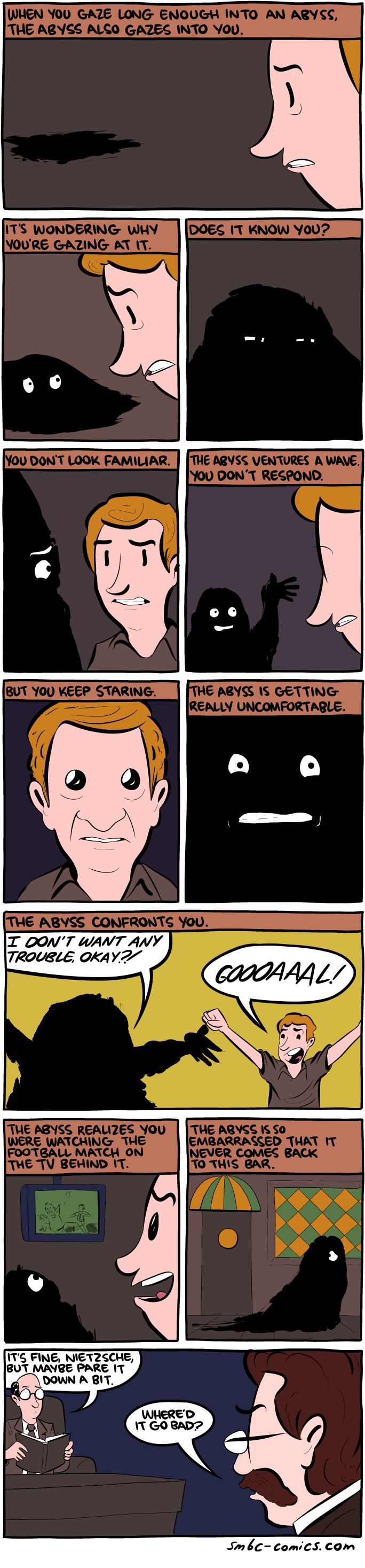
The comic takes the famous Nietzsche quote "When you gaze long enough into an abyss, the abyss also gazes into you" and plays it out literally. A man stares into an actual abyss (depicted as a dark void with eyes), and the abyss becomes increasingly uncomfortable with the attention. First, the abyss wonders why the man is staring. Then it asks if it knows him. The man does not look familiar. The abyss ventures a wave, but the man does not respond. The abyss gets "really uncomfortable" and eventually confronts the man, saying "I don'''t want any trouble, okay?" The man screams at the abyss, frightening it. The abyss then retreats to a friend'''s house, watches a football match, and avoids going home for a while. In the final panel, the abyss'''s friend asks "It warped it, didn'''t it? The gazing?" and the abyss admits it "jarred it a bit."
The Humor
The comedy comes from completely inverting the power dynamic of Nietzsche'''s famous aphorism. In the original quote, the abyss gazing back into you is meant to be a terrifying metaphor about how confronting darkness or evil can transform and corrupt you. In this comic, the abyss is not a terrifying cosmic force but a shy, socially anxious entity that finds the man'''s staring creepy and threatening. The abyss reacts the way a normal person would if a stranger kept staring at them on the street -- with discomfort, an attempt to defuse the situation, and eventually fleeing. The final reversal -- that the gazing did affect the abyss, just "a bit" -- is a gentle deflation of the philosophical gravitas of the original quote.
References
The comic is based on Friedrich Nietzsche'''s famous aphorism from "Beyond Good and Evil" (1886), section 146: "He who fights with monsters should look to it that he himself does not become a monster. And if you gaze long into an abyss, the abyss also gazes into you."