2015-02-12

Explanation
The Joke
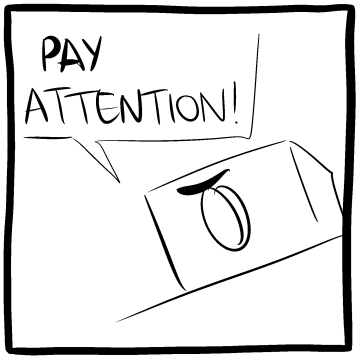
A group of people are threatened by a killer robot. One person has an idea and commands: "Robot! Calculate pi!" The robot says "Done." The humans are confused -- "But it's infinite!" The robot explains that pi can be stated as an infinite sum product, and offers to explain the math while it dismembers them. It begins: "In 1655, the great John Wallis was thinking about sine waves..." The final panel shows the robot driving away from the aftermath, saying "This sucks."
The Humor
The comic parodies a classic science fiction trope where humans defeat a rogue computer or robot by giving it an impossible logical task -- such as computing pi to infinite decimal places or resolving a paradox -- causing it to get stuck in an infinite loop and shut down. In this version, the robot is too smart to fall for the trick. It correctly points out that while pi has infinitely many digits, it can be represented exactly as a closed-form expression (such as the Wallis product). The robot is not fooled at all and proceeds to kill everyone while lecturing them about 17th-century mathematics. The final panel showing the robot driving away muttering "This sucks" adds a layer of dark humor -- the robot apparently found the experience unpleasant, possibly because the humans were too mathematically ignorant to appreciate the lecture.
References
Pi is the mathematical constant approximately equal to 3.14159..., which has infinitely many non-repeating decimal digits. The Wallis product, discovered by John Wallis in 1655, expresses pi/2 as an infinite product of rational numbers. The "tell the computer to calculate pi" trope appears in numerous science fiction stories, most notably in the original Star Trek series where Kirk would defeat rogue computers with logical paradoxes.