a-funny-universe
Explanation
The Joke
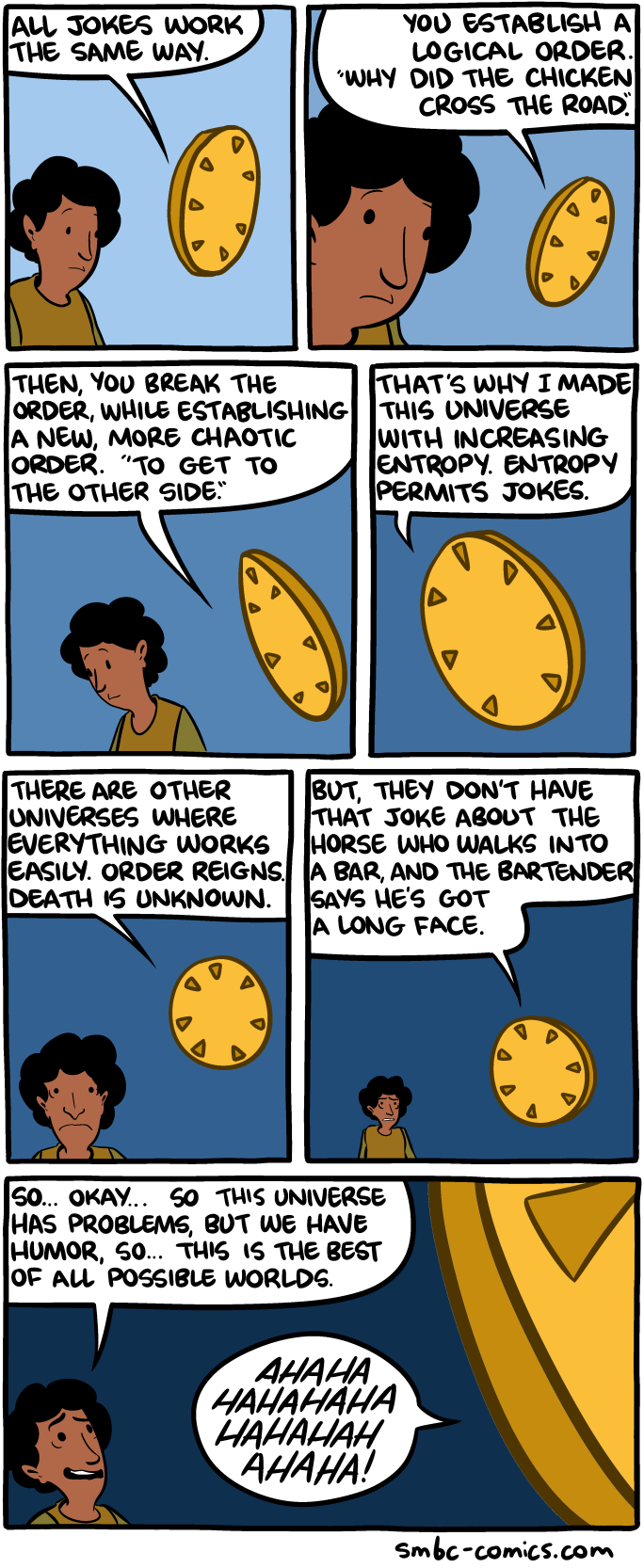
God (depicted as a smiley face) explains to a human how jokes work using the example of "Why did the chicken cross the road?" He says all jokes follow a pattern: you establish a logical order, then break the order while establishing a new, more chaotic order ("To get to the other side"). God then reveals that this is why he made the universe with increasing entropy — entropy permits jokes. He notes that other universes where everything works in easily understood, logical order don't have jokes — like the one about a horse walking into a bar where the bartender says he's got a long face. God concludes that while this universe has problems (and humor), it is "the best of all possible worlds." The audience laughs uproariously.
The Humor
The comic plays on the philosophical concept of Leibniz's theodicy — the idea that God created "the best of all possible worlds" — and gives it an absurd twist. Instead of justifying the existence of evil and suffering through some grand moral purpose, God's reason for creating a universe with entropy and disorder is simply that it allows jokes to exist. The second law of thermodynamics becomes a prerequisite for comedy. The alternate universes where everything is orderly and predictable are jokeless because humor relies on subverted expectations, which requires the possibility of disorder. The meta-humor is that the comic itself is a joke about how jokes work, using the structure of a joke (setup and subverted expectation) to explain that very structure.
References
- Leibniz's Theodicy: The phrase "the best of all possible worlds" comes from Gottfried Wilhelm Leibniz, who argued that God, being omniscient and benevolent, must have created the best possible universe despite the existence of evil and suffering.
- Second Law of Thermodynamics: The reference to increasing entropy describes the tendency of closed systems to move toward disorder, a fundamental principle of physics.