a-new-set-of-numbers
Explanation
The Joke
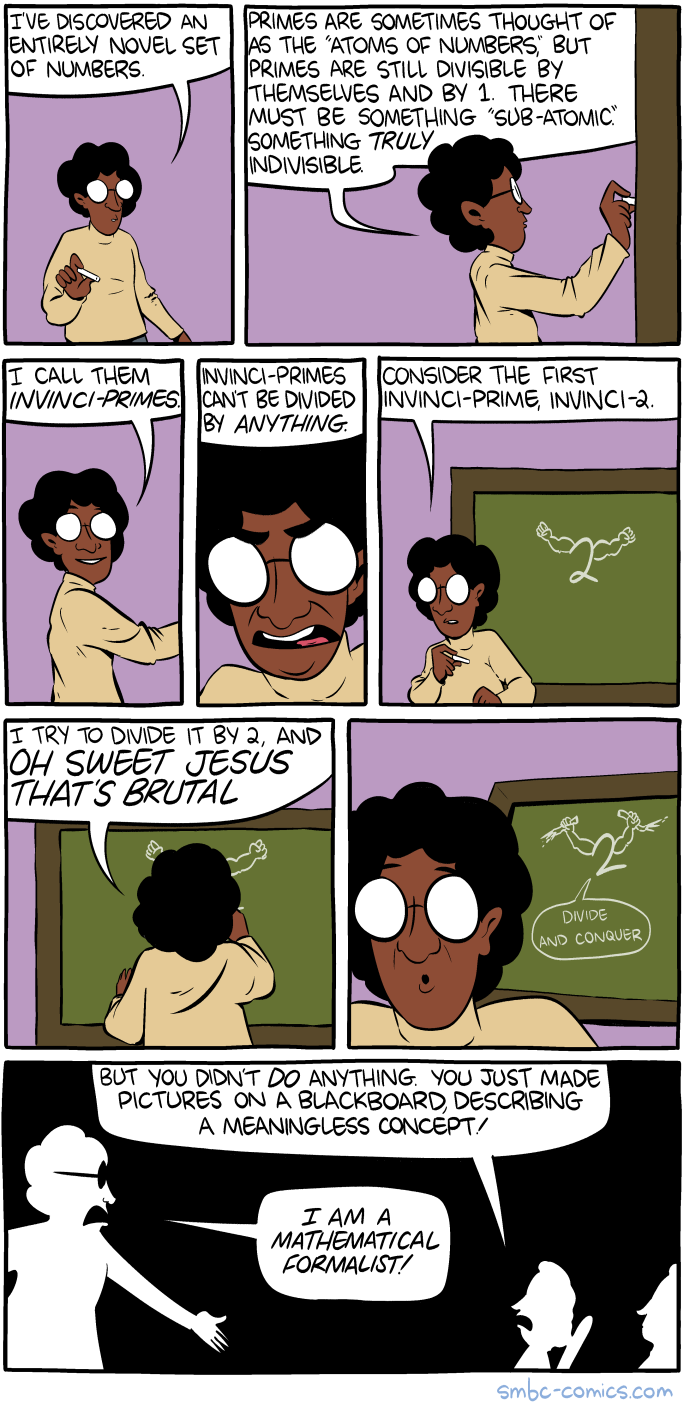
A mathematician announces that she has discovered a new set of numbers. She explains that primes are sometimes thought of as the "atoms" of numbers -- they are divisible only by themselves and 1. But she observes that primes are still divisible by themselves and by 1, so there must be something "sub-atomic" -- something more fundamental. She calls these "munu-primes," numbers that cannot be divided by anything, not even themselves.
She then asks the audience to consider the first munu-prime: "munu-i." When she writes it on the board and shows what happens when you try to divide it, someone in the audience screams "OH SWEET JESUS THAT'S BRUTAL" -- suggesting that the mathematical result is so horrifying or paradoxical that it causes existential distress. Someone else objects that she has not actually discovered anything real; she just drew pictures on a blackboard describing a meaningless concept. She proudly responds: "I am a mathematical formalist."
The Humor
The joke works on multiple levels for anyone familiar with mathematics. First, the concept of a number that cannot be divided by anything -- not even itself or 1 -- is inherently absurd and mathematically impossible, since any number divided by 1 equals itself and any number divided by itself equals 1 (except zero). The audience member's horrified reaction to the result of attempting such a division plays up this absurdity as if it were a Lovecraftian revelation too terrible for human minds to comprehend.
The punchline about mathematical formalism is the sharpest layer. Formalism is a real philosophy of mathematics (associated with David Hilbert) that holds mathematics is essentially a game of manipulating symbols according to rules, without those symbols needing to refer to anything "real." By declaring herself a formalist, the mathematician deflects the criticism that her numbers are meaningless -- in formalism, all mathematical objects are just symbol manipulation, so her meaningless numbers are no less valid than any others. This is both a genuine philosophical position and, in this context, a hilarious dodge.
References
The comic references several concepts in mathematics and the philosophy of mathematics. Prime numbers are indeed often described as the "atoms" or building blocks of arithmetic, since every integer can be uniquely factored into primes (the Fundamental Theorem of Arithmetic). Mathematical formalism, associated with David Hilbert, holds that mathematics is the manipulation of formal symbols according to fixed rules and does not require its objects to have any external meaning or reference. This contrasts with mathematical Platonism (numbers exist as abstract objects) and intuitionism (mathematics is a mental construction). The comic was published on Valentine's Day 2017.