a-proof
Explanation
The Joke
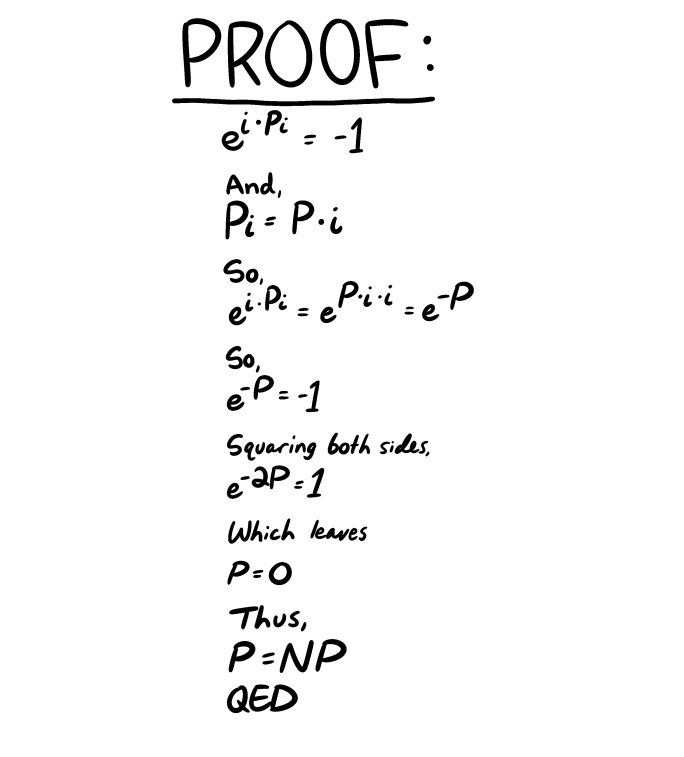
The comic presents a fake mathematical "proof" that P = NP. It proceeds as follows:
- Start with Euler's identity: e^(i*Pi) = -1
- Note that Pi = P * i
- Substitute: e^(iPi) = e^(Pi*i) = e^(-P)
- Therefore e^(-P) = -1
- Square both sides: e^(-2P) = 1
- This means -2P = 0, so P = 0
- "Thus, P = NP" (since N times 0 = 0)
- QED
The Humor
The comic is a parody of mathematical crankery -- the kind of bogus "proofs" that amateur mathematicians sometimes produce for famously unsolved problems. The P vs. NP problem is one of the most important open questions in computer science and mathematics (and one of the Clay Millennium Prize Problems worth a million dollars). The "proof" here exploits a deliberate equivocation: the "P" in the P vs. NP problem refers to complexity classes (sets of decision problems), while the "P" in the proof is treated as a simple numerical variable. The mathematical steps themselves also contain errors -- most notably, e^(-P) = -1 does not imply e^(-2P) = 1 in the way used here (squaring -1 gives 1, but squaring e^(-P) gives e^(-2P) only if you ignore that the original equation involves complex numbers). The final leap from "P = 0" to "P = NP" is the crowning absurdity, conflating a numerical value with a statement about computational complexity classes.
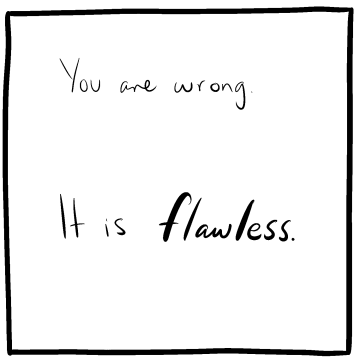
The votey ("You are wrong. It is flawless.") is the cranky mathematician's inevitable response to criticism, doubling down on the obviously wrong proof.
References
- P vs. NP is an unsolved problem in computer science asking whether every problem whose solution can be verified quickly (NP) can also be solved quickly (P). It is one of the seven Millennium Prize Problems.
- Euler's identity (e^(i*pi) + 1 = 0) is considered one of the most beautiful equations in mathematics, relating five fundamental constants.
- QED (quod erat demonstrandum) is Latin for "which was to be demonstrated," traditionally written at the end of mathematical proofs.