AGS
Explanation
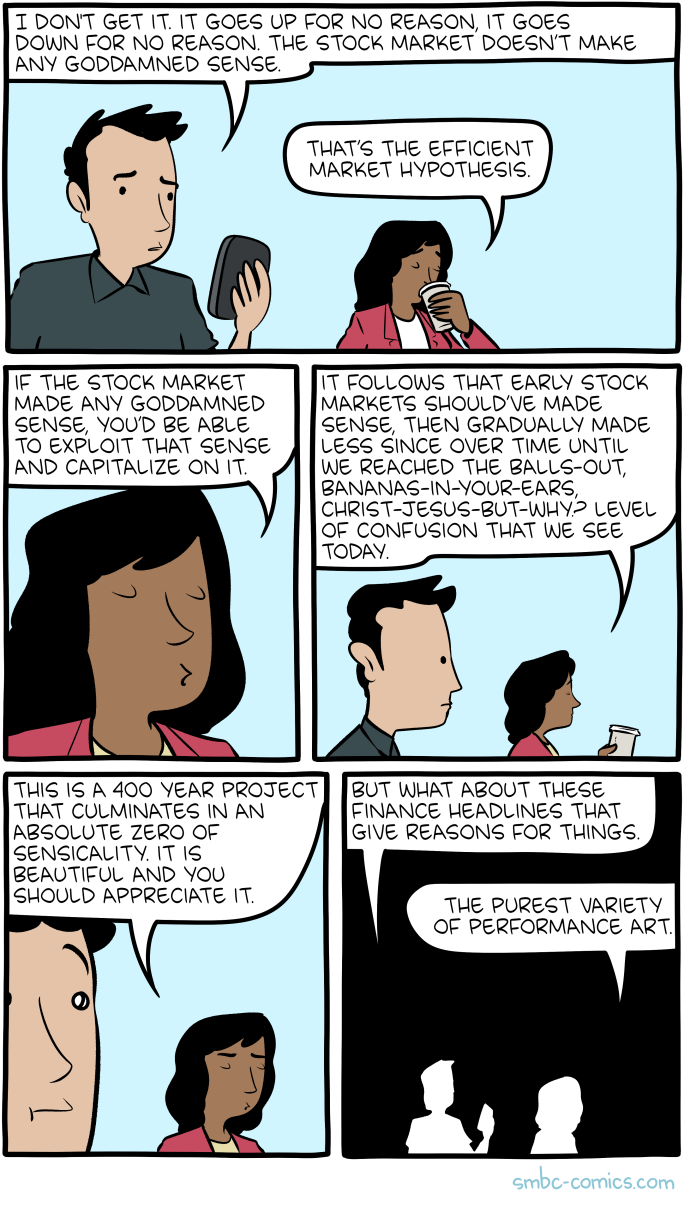
This comic riffs on the Efficient Market Hypothesis (EMH) from financial economics.
The first panel has a frustrated person complaining that the stock market makes no sense -- it goes up for no reason, down for no reason, and doesn't behave rationally. This represents the common layperson's frustration with seemingly random market movements.
A second character calmly responds: "That's the efficient market hypothesis." This is the joke's core inversion. The EMH, in its strong form, states that stock prices already reflect all available information, so price movements should appear random because only new, unpredictable information changes prices. The frustrated person thinks they're arguing against rational markets, but they're actually describing exactly what an efficient market would look like.
The comic then extends the joke. If the stock market historically "made any goddamned sense," that predictability would have been identified and exploited until the pattern disappeared -- which is precisely the mechanism by which markets become efficient. The character notes that early stock markets were more obviously irrational, but once enough people recognized and traded on those patterns, we reached the "balls-out, galaxy-brain, competition-saturated level" where remaining price movements appear random.
The final panel adds a meta-layer, noting that financial headlines treating random market movements as meaningful narratives could be considered "a form of performance art" -- since journalists are essentially crafting stories about what is, according to the EMH, fundamentally noise.