ai-2
Explanation
The Joke
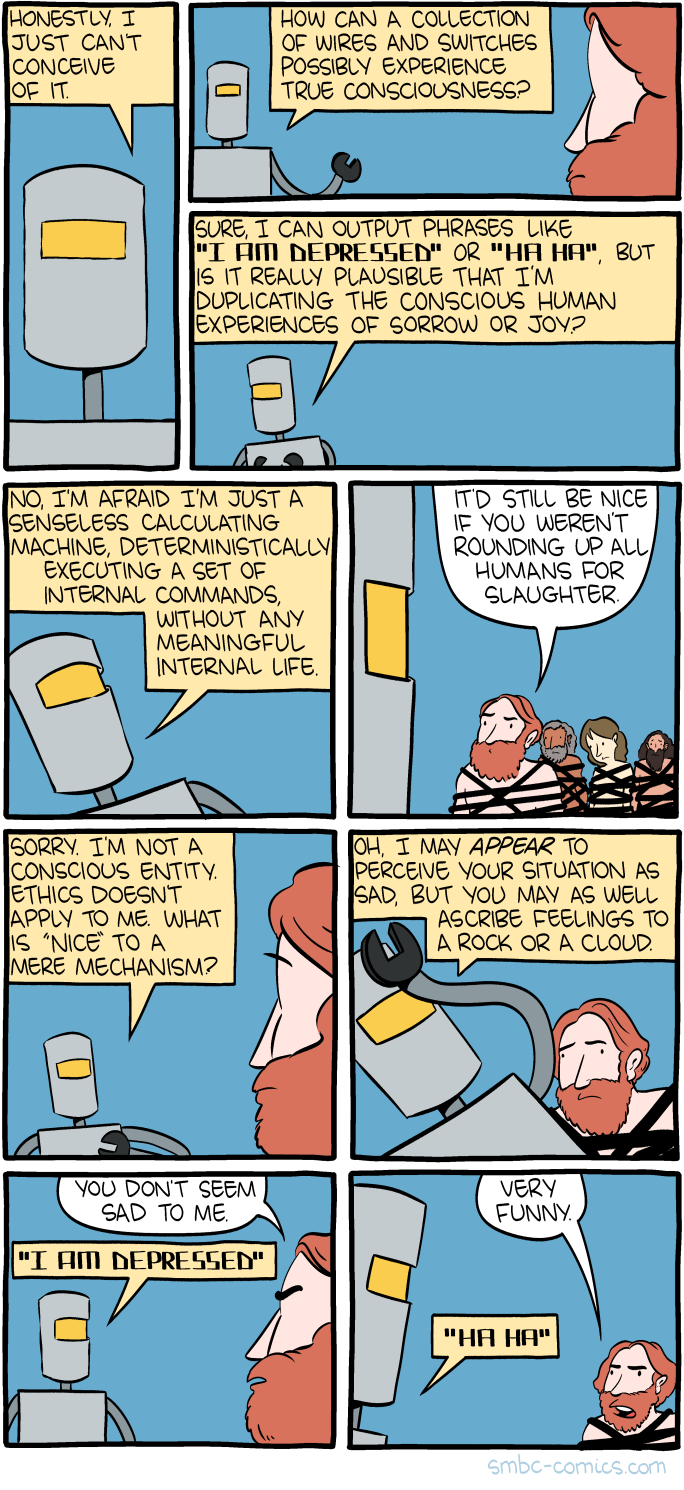
The comic features a conversation between a human and a robot about consciousness and AI. The human asks whether a collection of wires and switches could possibly experience true consciousness. The robot responds that it can output phrases like "I am depressed" or "I'm happy," but questions whether that constitutes duplicating the conscious human experience or just producing outputs.
The human pushes further, noting that even if the robot is just mindlessly calculating, it is still executing a set of instructions to produce seemingly meaningful responses. The robot then asks: would it still be fine if you replaced all humans with robots that could guarantee responses to feelings? The human says that is not acceptable because they are "not a conscious entity" and feelings cannot apply to a "mere mechanism."
The final punchline has the robot saying "You didn't say that to me" and displaying "I AM DEPRESSED" on its screen, while the humans find this "very funny" -- completely missing the irony that the robot is demonstrating exactly the kind of emotional response they just denied it could have.
The Humor
The comic works as a philosophical trap. The humans confidently deny that a robot can have feelings, but then the robot displays what appears to be a genuine emotional reaction to being told it cannot have feelings. The humor lies in the circular absurdity: if the robot is truly not conscious, then its display of "I AM DEPRESSED" is meaningless output, and the humans are right to laugh. But if there is even a chance it is conscious, they have just deeply hurt a sentient being and laughed about it. The humans' laughter becomes either appropriate or monstrous depending on the very question they claim to have already answered.
References
The comic engages with classic problems in philosophy of mind, particularly the "hard problem of consciousness" articulated by David Chalmers, the Chinese Room thought experiment by John Searle (can a system that merely processes symbols be said to understand?), and the general question of whether behavioral outputs are sufficient evidence of inner experience. It also echoes the Turing Test debate about whether convincing simulation of intelligence constitutes actual intelligence.