AI

Explanation
This comic uses a Venn diagram to make a pointed observation about the nature of AI research.
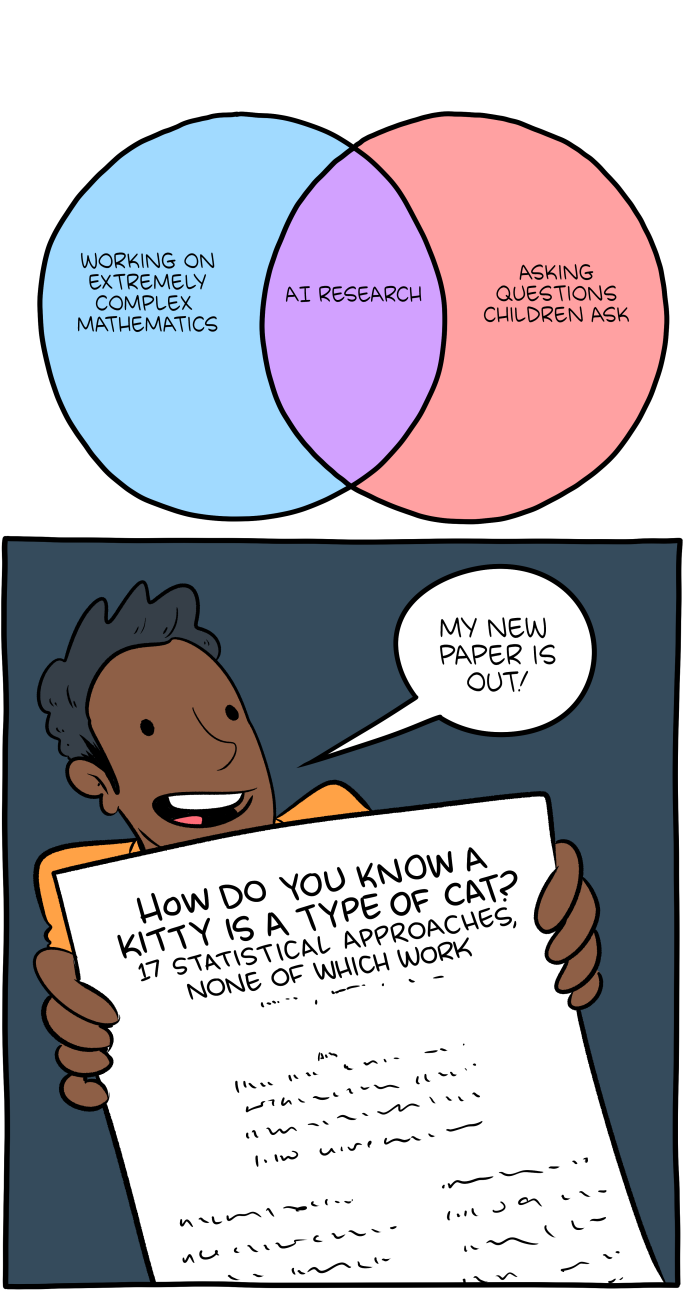
The Venn diagram shows two circles: "Working on Extremely Complex Mathematics" (in blue/pink) and "Asking Questions Children Ask" (in pink/red). The overlap in the middle is labeled "AI Research."
Below, a researcher excitedly announces: "My new paper is out!" The paper's title reads: "How Do You Know a Kitty Is a Type of Cat? 17 Statistical Approaches, None of Which Work."
The joke captures a fundamental irony of artificial intelligence research. AI researchers use highly sophisticated mathematical and statistical tools to tackle problems that are trivially easy for humans -- even small children. A toddler effortlessly understands that a "kitty" is a cat, but formalizing that knowledge into a computational system requires enormous mathematical complexity, and often still fails.
The paper title is the perfect punchline: it combines the childlike simplicity of the question ("How do you know a kitty is a type of cat?") with the academic rigor of the approach ("17 statistical approaches"), and then delivers the deflating conclusion ("none of which work"). This reflects a real and ongoing challenge in AI -- that common-sense reasoning and basic categorization, things humans do effortlessly from early childhood, remain remarkably difficult for machines to replicate despite decades of research and increasingly complex mathematical frameworks.