alone-2

Explanation
The Joke
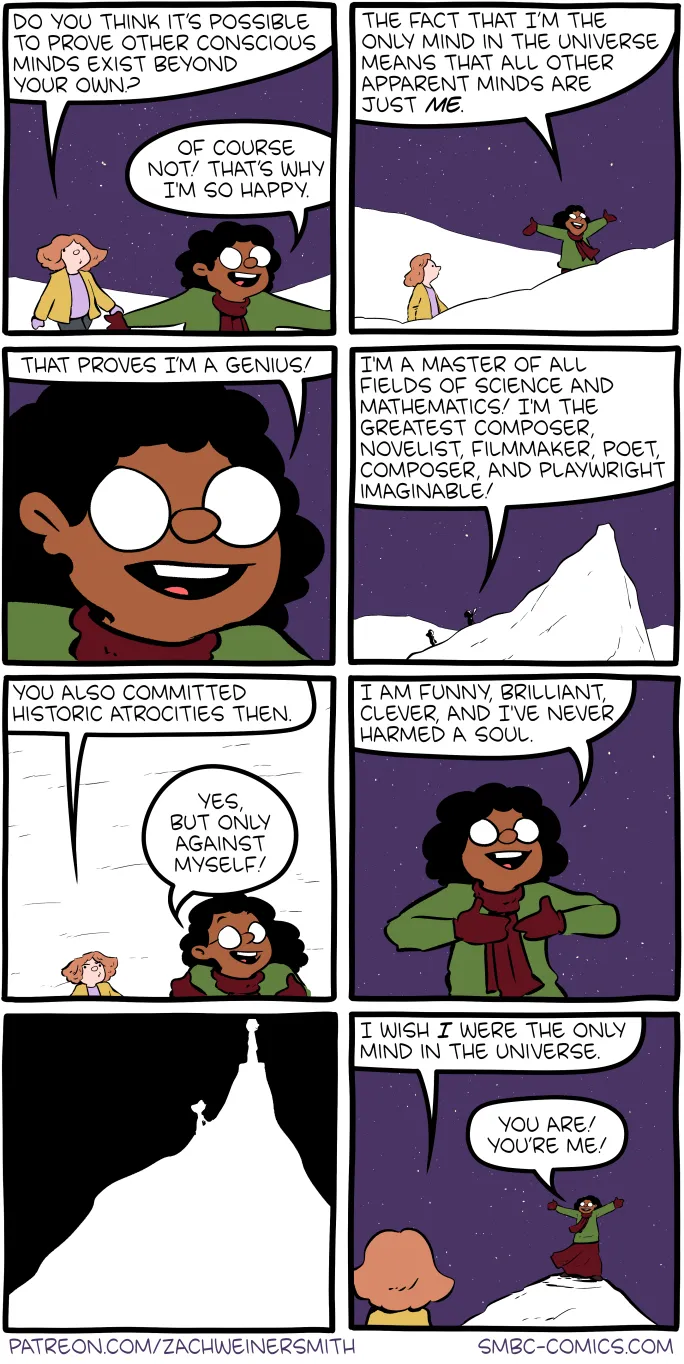
A woman asks a man with glasses: "Do you think it's possible to prove other conscious minds exist beyond your own?" He cheerfully replies: "Of course not! That's why I'm so happy." He then explains his solipsistic worldview: since he is the only mind in the universe, all other apparent minds are just him. "That proves I'm a genius!" he declares. He claims to be a master of all fields of science and mathematics, the greatest composer, novelist, filmmaker, poet, and playwright imaginable. The woman points out: "You also committed historic atrocities then." He waves this off: "Yes, but only against myself!" He then declares: "I am funny, brilliant, clever, and I've never harmed a soul."
In the penultimate panel, the woman walks away, seen from behind as a tiny figure on a mountain. In the final panel, the solipsist stands on a mountaintop with arms outstretched, and the woman says: "I wish I were the only mind in the universe." The solipsist joyfully responds: "You are! You're me!"
The Humor
The comic is a philosophical satire of solipsism — the idea that only one's own mind can be known to exist. The man takes solipsism to its logically consistent but absurd conclusion: if he is the only conscious being, then he gets credit for every human achievement (all the great art, science, and literature were created by "him") while simultaneously being absolved of all moral responsibility for atrocities (since he only harmed "himself").
The comedy escalates as each supposed benefit of solipsism is presented with manic enthusiasm. The woman's objection about atrocities is the sharpest moment — it reveals that solipsism doesn't just give you credit for Shakespeare, it also gives you credit for Hitler, but the solipsist cheerfully sidesteps this by noting it was all self-harm.
The final exchange is the perfect capper: when the woman expresses a genuine wish to be alone (clearly exasperated by this conversation), the solipsist co-opts even her frustration, insisting she is already him. The joke captures how solipsism is both logically irrefutable and completely useless as a worldview — and how a committed solipsist is impossible to argue with, since any counterargument is just them arguing with themselves.