an-ethical-trilemma
Explanation
The Joke
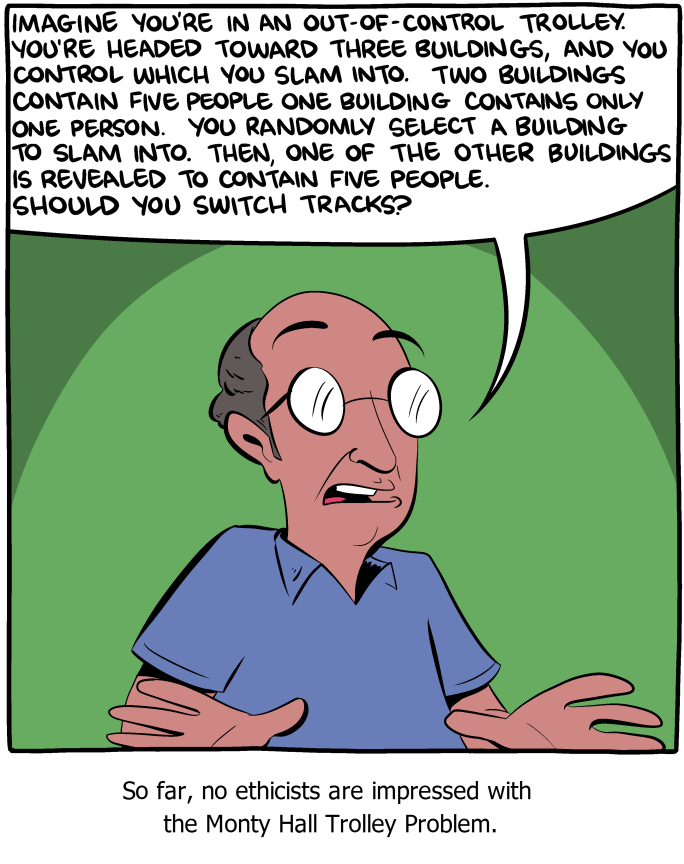
A professor presents a scenario: "Imagine you're in an out-of-control trolley. You're headed towards three buildings, and you control which one you slam into. Two buildings contain five people. One building contains only one person. You randomly select a building to slam into. You hit one of the five-person buildings. It is revealed that one of the other buildings contains five people. Should you switch targets?" The caption reads: "So far, no ethicists are impressed with the Monty Hall Trolley Problem."
The Humor
The comic brilliantly mashes together two of the most famous thought experiments in their respective fields: the Trolley Problem from ethics and the Monty Hall Problem from probability/game theory. In the classic Monty Hall Problem, a contestant picks one of three doors, one is revealed to be a losing door, and switching to the remaining door statistically improves your odds. In the classic Trolley Problem, you must decide whether to divert a trolley to kill fewer people. By combining them, the comic creates a scenario where the mathematical logic of Monty Hall (you should switch!) leads to an ethically monstrous conclusion -- you would be actively choosing to redirect a trolley toward a building you NOW know contains only one person, which feels more like murder than the passive original choice. Ethicists are unimpressed because the probabilistic framing trivializes the moral weight of the decision.
References
The Trolley Problem was introduced by philosopher Philippa Foot in 1967 and further developed by Judith Jarvis Thomson. The Monty Hall Problem is named after the host of the game show Let's Make a Deal and was famously analyzed by Marilyn vos Savant in her Parade magazine column in 1990. In the classic Monty Hall setup, switching doors gives you a 2/3 chance of winning versus 1/3 for staying.